Table of Contents▼
Festival DJs use four CDJs for reasons that go far beyond just mixing music. This guide covers:
- Redundancy: Backup decks in case of hardware failure
- Environment: CDJs handle heat, dust, and light rain far better than laptops
- Sound Quality: Standalone CDJs upscale audio — laptops can't match it
- Legacy: Multi-deck setups date back to the 1970s disco era
- Visuals: Extra decks can control lighting, pyro, and LED walls
In most clubs, lounges, and bars, the standard DJ setup usually consists of a mixer, two decks (whether CDJs or turntables), and a laptop — or in some cases, a DJ controller and a laptop.
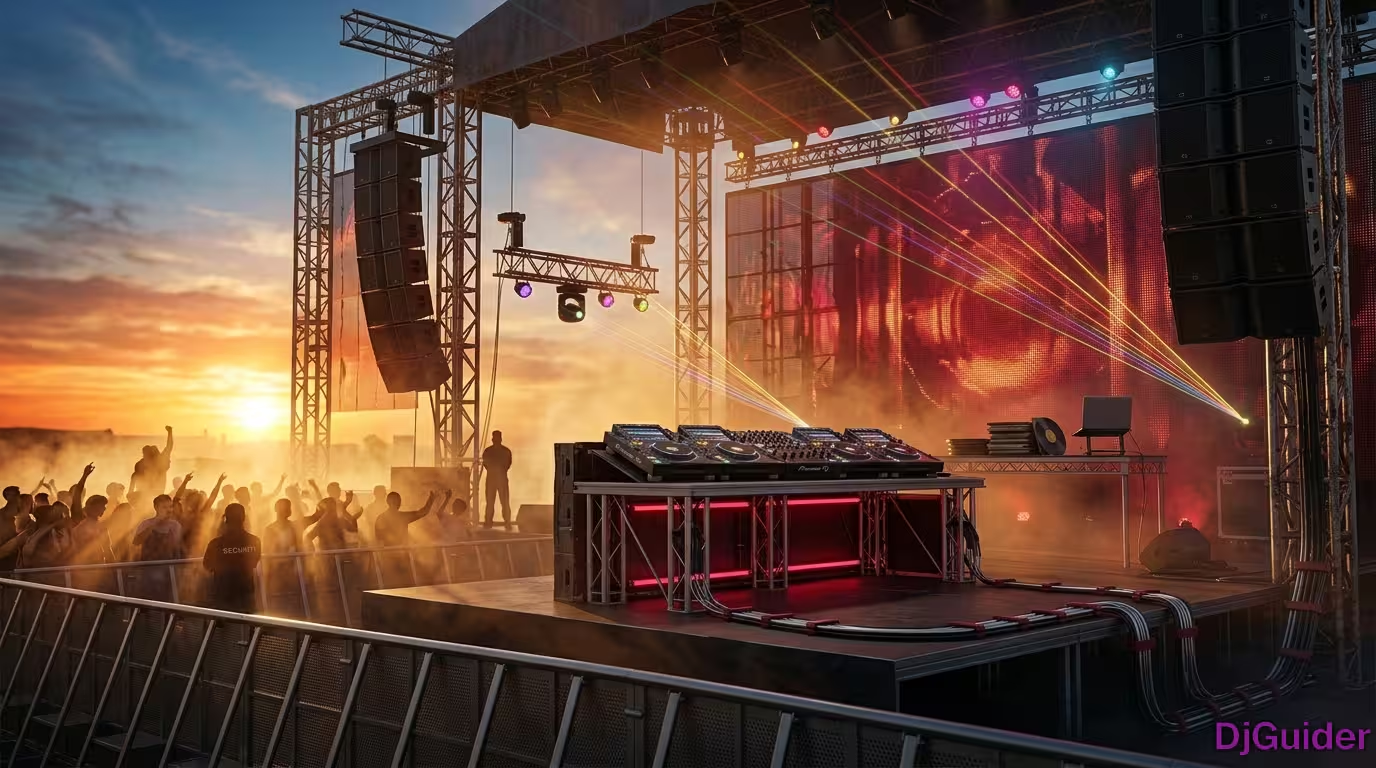
But on most music festival stages, we see a standard complement of three or four CDJs and a DJ mixer with no laptop in sight. When you listen to many of these artists, most of how they perform can basically be done on two CDJs.
So why the extra gear?
What Is a CDJ?
A CDJ is a specialized digital music player used by DJs. CDJs can play digital music from CDs, USB flash drives, or memory cards.
| Question | Answer |
|---|---|
| What is a CDJ? | Specialized digital music player for DJs |
| What can it play? | CDs, USB flash drives, memory cards |
| Modern features | Network linking, HID mode, sample rate upscaling |
Why Do Festival DJs Need 4 CDJs?
Despite all the rumors we hear perpetuated by DJs on the internet, I've done an in-depth analysis of festival performances. Along with the instructors that I work for, we've done mix deconstructions of Skrillex, Diplo, and others — many of them are doing real mixing.
My point: while pre-recorded sets do sometimes happen, they're not as often as they're blown up to be. Remember when播放某艺人 played at Ultra and everyone accused them of playing a fake set because the RCA wires weren't connected to the CDJs? Very few people understood that they were using HID mode.
Here are the real reasons festival stages use three or four decks:
1. Redundancy and Modularity
Because of the high-profile nature of the festival stage — especially when it's being filmed, broadcast, and streamed — mistakes cannot be made during a set.
| Scenario | 2-Deck Setup | 4-Deck Setup |
|---|---|---|
| One deck fails | Set compromised or done | 2 backup decks ready |
| Controller fails | Set is over | Modular — swap individual units |
| Need backup | Hope you have a pre-recorded set | Instant backup available |
Even if the artist is only playing on two of those CDJs, they have an additional two CDJs as backup — just in case the primary two give any trouble.
A fun side note: the CDJ-3000 can be linked up to six units together and paired with a six-channel mixer like the Pioneer DJM-V10.
For DJ software users who use Rekordbox, Serato, Traktor, or Virtual DJ, there's an emergency tactic called "Instant Doubles" — you can control both decks using one physical deck. But hardware redundancy is still more reliable.
2. Environment
What kind of environment is a festival stage? Unlike laptops — especially Intel-based MacBooks — standalone gear like CDJs is designed to operate at higher ambient temperatures.
| Factor | Laptop | CDJ-3000 |
|---|---|---|
| Max operating temp | ~95°F (35°C) before throttling | 150°F (66°C) |
| Thermal throttling | Begins around 90°F | None at festival temps |
| Water resistance | None — a sprinkle can kill it | Can handle light drizzle |
| Dust / sand resistance | Clogs vents, causes overheating | Built to resist particles |
| Reliability in heat | Glitchy audio, shutdowns | Flawless operation |
A laptop used for DJing will begin to thermal throttle at high temperatures, resulting in glitching noises, audio dropouts, performance lag, and often spontaneous shutdowns. Not every laptop is like the XMG DJ 15 that was tested in the desert at 104°F.
The CDJ-3000 is rated to operate at up to 150°F (66°C) — way above where most laptops can operate.
On top of that, while modular DJ gear is not exactly waterproof, it can take a little sprinkle here and there without catastrophic failure. Dust and dirt particles won't stop a CDJ from functioning. Newer CDJs like the CDJ-3000 are built to be resistant to dust particles — the jog wheel will still function smoothly.
3. The Extra Decks Aren't Always for Music
There's an Armin van Buuren video where he explains how he uses the outside two decks. What he had was a timecode signal inside each of those decks, and he uses it to control visuals on the giant display that goes with the music.
| Use Case | How It Works |
|---|---|
| Visual control | Timecode signal in extra CDJs syncs graphics to tempo |
| LED wall sync | Engineer coordinates visuals from front of house |
| Pyro / lighting | Tempo-synced effects using the CDJ as a controller |
| Show control | DJM mixers can sync with show control software |
| Volume limiting | FOH engineer can remotely control stage volume |
The idea: in order for the graphics to sync up to the tempo of the music, Armin had to manually set it using the CDJ because there's no way the engineer can guess what tempo the song is played at. Today, CDJs and DJMs can be configured to sync with software like Show Control.
4. Sound Quality
This reason is not so much about why you use four, but more of an explanation of why you use CDJs at all versus using a controller.
| Factor | Controller / Laptop | CDJ-3000 + DJM |
|---|---|---|
| Noise floor | Audible at high volumes | Very low |
| Signal-to-noise ratio | Good | Excellent |
| Sample rate upscaling | No | Yes — real-time interpolation |
| Master tempo quality | Software-dependent | Hardware-optimized |
| Clarity at high volume | Can get muddy | Crystal clear |
On a large concert-level sound system, sound quality becomes very apparent. If you've ever been to a music festival, there are long moments where the gear is set up but there's no music playing. The mixer and everything plugged into it better not have an audible noise floor.
The CDJ-3000 does real-time upscaling of the sample rate through interpolation — similar to taking a 1080p video and upscaling it to 4K while retaining sharpness.
If you ever get a chance to play on CDJ-3000s, try this: play standalone with a USB drive (the upscaling happens), then play in HID mode using Rekordbox in performance mode. There's a difference in sound quality. It's further apparent at extreme tempo settings when master tempo is engaged.
Best of Both Worlds: Link Export Mode
If you want the best of both worlds — laptop convenience and CDJ sound quality — use Rekordbox's Link Export mode. It links your computer with the CDJs the same way a USB drive would, and the hardware upscaling still happens at the CDJ level. You can choose songs on your laptop, but the playback engine still happens on the CDJ hardware.
5. Legacy
Having more than two decks has been around since the early days of dance music. If you look at old photos of Larry Levan at the Paradise Garage back in the late 1970s, you would often find three or more turntables and a wide 19-inch rotary DJ mixer.
| Era | Setup | Why |
|---|---|---|
| 1970s Disco | 3+ turntables + rotary mixer | Queuing vinyl takes time |
| 1980s Hip-Hop | 2 turntables + crossfader mixer | Scratching, back-cueing, portability |
| 2000s Club | 3-4 CDJs + mixer | CD burning — one song per disc |
| Today's Festival | 4 CDJ-3000s + DJM-V10 | Fusion of both worlds |
The reason behind multiple turntables was simple: unlike digital DJ gear today, you can't instantly preview and queue up songs with vinyl. It takes time to pull out records. Even with CDs, it still took time to search and load. Some artists like Armin van Buuren would burn only one song per CD to avoid sifting through the booklet.
Where Did the 2-Deck Setup Come From?
The two-deck and mixer setup was embraced by early hip-hop DJs — turntable, mixer, turntable. This made sense for back-spinning, scratching, and juggling records. It also helped with portability. Early hip-hop DJs opted for smaller mixers that brought the turntables closer together with slider volume controls and the crossfader.
What we see on a festival stage today is a fusion and evolution of these two different worlds:
| Influence | From Disco | From Hip-Hop |
|---|---|---|
| Number of decks | 3+ decks | — |
| Mixer type | Rotary, wide | Crossfader, compact |
| Performance style | Blending, long mixes | Scratching, quick cuts |
| Modern fusion | 4-deck setup | Crossfader mixer |
Today's festival setup is a side-by-side configuration using a mixer with a crossfader (like early hip-hop heads preferred) with three or more decks (like disco-era DJs). It's approachable by everyone — if you only want two decks, you're set. If you want four, you're still set. You can even add a laptop to the mix.
Summary: The 5 Reasons
| Reason | Summary |
|---|---|
| 1. Redundancy | Backup decks in case of hardware failure — no room for error on a broadcast stage |
| 2. Environment | CDJs handle heat (150°F), dust, and light rain — laptops thermal throttle at 95°F |
| 3. Visuals / Show Control | Extra decks control LED walls, pyro, lighting, and graphics via timecode |
| 4. Sound Quality | CDJ-3000s do real-time sample rate upscaling — laptops can't match the clarity |
| 5. Legacy | Multi-deck setups date back to the 1970s disco era — it's how dance music evolved |
I've seen Diplo play on Serato, and Skrillex used to be a Traktor user. Whether you prefer 2 decks or 4, the festival setup accommodates everyone. Hopefully this clarified why festival DJs have a four-CDJ setup.