Table of Contents▼
In This Article
- The Setup: CDJs vs Vinyl Turntable Side by Side
- What Information Does a CDJ Give You That Vinyl Doesn't?
- What Information Does a Vinyl Turntable Give You?
- How Mixing on CDJs Works: Beat Matching With Digital Tools
- How Cueing Works on Vinyl: Finding Your Cue Point Manually
- Start and Stop Speeds: The Physical Motor Challenge
- Beat Matching by Ear: The Real Skill of Vinyl DJing
- A Live Vinyl Beat Match Demonstration
- CDJs vs Vinyl: What Each Format Is Really Good For
- CDJs vs Vinyl Turntables: Quick Comparison
Vinyl DJs have to be some of the most passionate people in the world when it comes to the craft of DJing.
Whenever I see DJs that use CDJs or controllers post video content online, rest assured the vinyl DJs are very very quick to jump on those bits of content. They say that doesn't impress me, it's not proper DJing because it's not using vinyl turntables.
I thought it would be really interesting to show you a bit of a comparison between DJing on CDJs and also DJing on vinyl. I'm not trying to divide people or anything like that by saying that DJing on vinyl is the only method for real DJing. That's not the idea behind it at all.
What I hope to show you is where some of that passion comes from and why vinyl DJs are so passionate about the craft of DJing. It certainly is a skill to be able to DJ on vinyl. I'm somebody that used to be able to DJ on vinyl, I'm very very rusty now, because that's how I started.
I then moved to CD and now I'm on digital methods like controllers and CDJs. I have a bit of a background and I've been able to play with both methods. So I thought I would share with you the different things to consider when DJing on both formats.
I'm somebody that used to be able to DJ on vinyl, I'm very very rusty now, because that's how I started. I then moved to CD and now I'm on digital methods like controllers and CDJs. I have a bit of a background and I've been able to play with both methods.
The Setup: CDJs vs Vinyl Turntable Side by Side
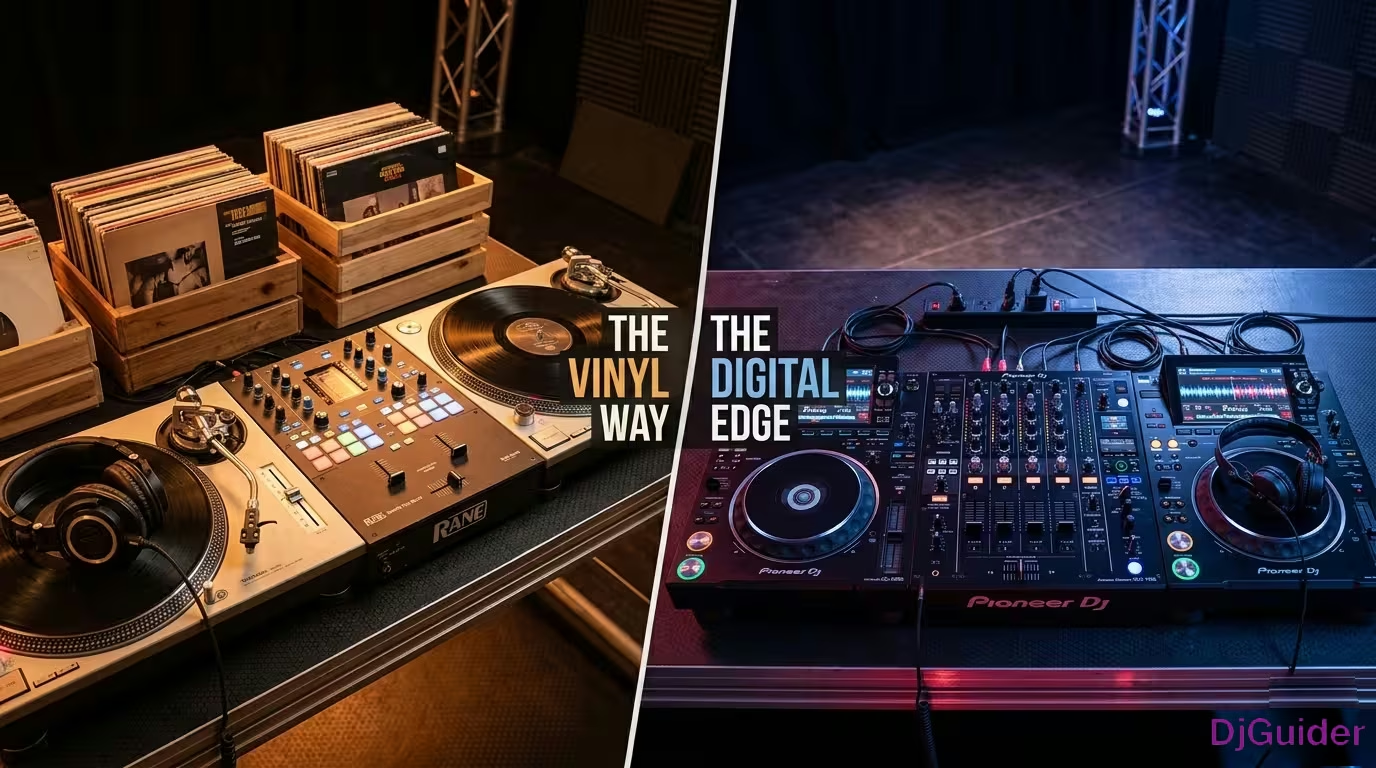
I've got two CDJ 3000s, and the CDJ setup is quite interchangeable with the controller, and I've got one vinyl turntable here.
I honestly regret selling my 1210s back in the day, but because I don't DJ on vinyl that much anymore, I like to have a bit of nostalgia. Before we really start to consider some of the mechanics of mixing on whichever chosen format you have decided, let's look at the fundamental differences of the CDJ or controller and a vinyl turntable side by side.
You can instantly see that on the CDJ or the controller via your laptop screen, you are at an instant advantage in terms of the information available to you. This is in comparison to what you have on a vinyl turntable.
What Information Does a CDJ Give You That Vinyl Doesn't?
When you load a track into a CDJ, you have got information at your fingertips like the BPM readout, the key information, and even the waveform.
If you're not on a CDJ, this will be on your laptop screen. Even just that information I've just explained is so so powerful.
The other piece of information that you don't get on a vinyl turntable is how much the tempo is adjusted by. If I move the tempo slider you adjust that and you get a readout of as to how much you have adjusted the speed of the record by. That's really really quite powerful.
Then of course within the waveform, because of the technology built into the CDJ, you can also store cue points and multiple cue points at that.
| Information Available | CDJ | Vinyl Turntable |
|---|---|---|
| BPM Readout | ✅ Precise digital readout | ❌ Must match by ear |
| Key Information | ✅ Displayed on screen | ❌ Must identify by ear |
| Waveform Display | ✅ Full waveform visible | ❌ No visual aid |
| Tempo Adjust Readout | ✅ Exact percentage shown | ❌ Only numbered markings |
| Cue Points | ✅ Saveable, multiple, instant | ❌ Manual, found by feel |
What Information Does a Vinyl Turntable Give You?
On a vinyl turntable you have absolutely none of that — you essentially have a record on a platter which is basically ready to go.
You can adjust the speed of the record depending on if it's a single or an album, sort of by 33 RPM or 45 RPM — that's just how quickly the turntable moves. You've got the target light so that will help you cue up your tracks, and it lights up the vinyl a bit.
In the bottom right hand corner you have got a tempo adjust but no readout. You can see there is a two, a four, a six and an eight, and you do have a tempo range as well, but it doesn't give you a digital readout as to how much you've actually adjusted the record by. It certainly doesn't have a BPM counter either.
- A record on a platter ready to go
- 33 RPM / 45 RPM speed selector
- A target light to help cue up tracks
- A pitch slider with markings (2, 4, 6, 8) but no digital readout
- No BPM counter
- No waveform
- No key information
- No saveable cue points
How Mixing on CDJs Works: Beat Matching With Digital Tools
This is going to be a very simple beat mix — we're not going to be focused on looping or hot cues or anything like that, because that's not available on vinyl turntables.
It's literally mixing one into the other that is the real true comparison here. This is really focusing on the core differences between CDJs, controllers, and traditional vinyl DJing, and the mechanics that are involved with that.
As soon as you hit play or cue on the CDJ it's an instant start. You can also save the cue points of course in the software on your USB or on your laptop, so you could jump to different cue points at the touch of a button. That is so much quicker, it's so easy.
When it comes to mixing, because of that instant start and because of the BPM readouts, it makes life very very easy for you. All you have to do is hit play, hit play on the next track, and as long as it's in time, some minor adjustments obviously. You've got an instant start on both tracks, you can match the BPMs via the readout, and as long as you sort of adjust things to make sure it is in time very very slightly on the jog wheels — which is also pretty instantaneous in terms of controlling that speed — it's going to be a very very quick and easy way to mix your tracks together.
This is where I think CDJs have taken almost like the strain away from mixing, allowing DJs to do more complex techniques using loops, using hot cues, and the other tools available at your disposal.
How Cueing Works on Vinyl: Finding Your Cue Point Manually
On the CDJ the cue loaded straight away at the start of the track and you can basically hit play and you're ready to go — the same cannot be said about a vinyl turntable.
You have to actually find your cue point manually, and you would do this by moving the record. If we want the cue point to be at the start of the record, you find the first beat, and it's basically a case of releasing the record when you want it to start.
This is why a lot of vinyl DJs who knew their records inside out had little stickers all over their records. Because that is their way of locating the cue point.
You have to actually find your cue point manually, and you would do this by moving the record. This is why a lot of vinyl DJs who knew their records inside out had little stickers all over their records. Because that is their way of locating the cue point.
Start and Stop Speeds: The Physical Motor Challenge
With a vinyl turntable, because this is a physical motor, it's going to take a couple of seconds to get up to the speed which is the BPM that's playing.
You can hear it takes a little bit of time for that motor to catch up. It's a little bit like when you adjust the touch release and the brake on a CDJ — and that's why it's there really, for the ex-vinyl DJs to have a bit more of a natural feel.
What this also means is that you are going to have to be constantly adjusting the speed in order to beat match it to the outgoing record using the tempo, but also some manipulation of the platter. Hence why it's quite similar to what you would do on the jog wheel.
The only difference is you're dealing with something that's actually physically moving as opposed to something that's digital. So the responsiveness is going to vary from deck to deck, because it just depends on what motor is inside there.
With a vinyl turntable, because this is a physical motor, it's going to take a couple of seconds to get up to speed. The responsiveness is going to vary from deck to deck because it just depends on what motor is inside there. On a CDJ, you get instant start every time.
Beat Matching by Ear: The Real Skill of Vinyl DJing
You don't have a reading of the BPM like you do on the CDJ, so you're going to have to do all of the work via your ears.
You're going to have to beat match manually. You also don't have a master tempo, so bear in mind that when you adjust the tempo slider it's also going to adjust the key of the track as well. It can make for some very very interesting blends, and hence why the reliance is on your ears a lot.
This is where vinyl DJs get so so passionate, because it takes so much time and it takes so much practice in order to get this right.
This is where vinyl DJs get so so passionate, because it takes so much time and it takes so much practice in order to get this right.
A Live Vinyl Beat Match Demonstration
It started off fairly on time — I actually picked two records that naturally were fairly similar BPMs — however this one did start to drift a little bit.
You could see there I was trying to make minor adjustments to not only the pitch slider, to adjust the overall speed of the motor going kind of down a bit and up a bit, and it got in time a bit and then it drifted out again a little bit. You also have to make minor adjustments to the actual platter itself while it's spinning to try and slow the motor down a bit.
It is an art form and it takes time to do. For quick mixing, if you want to just get a couple of bars beat matched and then very quickly mix in and mix out, you might get away with it and it probably doesn't need too much practice.
But for longer blends, especially like the old trance DJs back in the day, the big progressive house DJs — it really was an art form. This is why vinyl DJs are just so passionate about it, because so many hours has gone into not only beat matching by ear and learning how to manipulate a physical moving motor in order to get the speeds right.
But also as well knowing your phrasing without any kind of help from a screen. Knowing your keys by purely listening — of course with the tempo adjust it does adjust the key as well, it's like a pitch shift too. So there's so much to learn and to do by ear and manually.
CDJs vs Vinyl: What Each Format Is Really Good For
CDJs are brilliant for more complex techniques with loops and hot cues, pushing buttons quickly, effects, and all the rest of it.
But I would say there is definitely an art form in mixing by vinyl. The basics of beat matching on vinyl is very very difficult to master.
Clearly on the CDJs it has made mixing a lot easier, but it does open the door to creativity in other ways. Whereas with vinyl the emphasis was all on beat matching, knowing your tracks inside out, and finding cue points — all manually. A craft within itself in my opinion.
CDJs are brilliant for more complex techniques with loops and hot cues. Clearly on the CDJs it has made mixing a lot easier, but it does open the door to creativity in other ways. Whereas with vinyl the emphasis was all on beat matching, knowing your tracks inside out, and finding cue points — all manually. A craft within itself.
CDJs vs Vinyl Turntables: Quick Comparison
| Feature | CDJs / Controllers | Vinyl Turntables |
|---|---|---|
| BPM Readout | Yes — displayed on screen | No — must match by ear |
| Key Information | Yes — displayed on screen | No — listen manually |
| Waveform Display | Yes | No |
| Tempo Adjust Readout | Yes — precise percentage | No — no digital readout |
| Cue Points | Instant, saveable, multiple | Manual — found by feel or sticker |
| Start Speed | Instant | Motor spin-up delay |
| Key Lock / Master Tempo | Yes | No — tempo shift changes key |
| Beat Matching Method | BPM readout + jog wheel | By ear + platter manipulation |
| Best For | Complex techniques, loops, hot cues | Pure mixing craft, ear training |