Table of Contents▼
In This Article
- The Basic Reason DJs Use One-Ear Headphone Monitoring
- How the Cueing System on a DJ Mixer Actually Works
- Blending vs. Cutting: Two Different DJ Approaches
- Matching Tempo Across Different Songs
- Why DJs Feel Pressure to Keep Tempo Constant All Night
- Why DJs Try to Disguise the Ends of Songs
- Dance Cultures That Actually Want to Hear Song Beginnings and Endings
- The Economic Reason Bar Owners Might Not Want Non-Stop Dancing
- Beat Matching and Breakdancing: Why Tempo Consistency Is Critical
- When Audiences Actually Enjoy a Change of Tempo
- How DJs Transition Between Different Tempos
- Other Reasons DJs Use Headphones Beyond Beat Matching
- The Case for Using Two-Ear Headphone Monitoring
- Why DJs Should Take Their Headphones Off Completely Sometimes
- Summary: DJ Headphone Techniques Compared
- Quick-Start Guide: Headphone Technique by Gig Type
The Basic Reason DJs Use One-Ear Headphone Monitoring
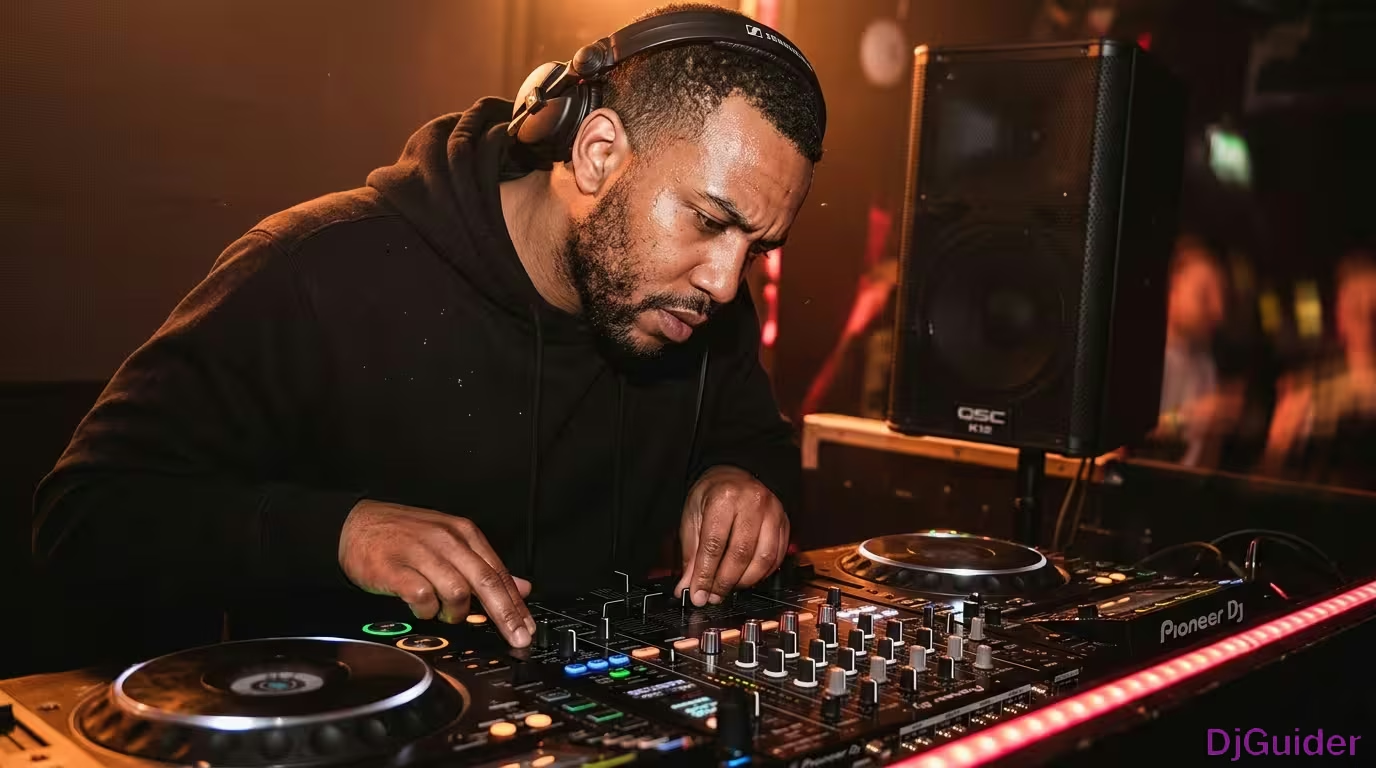
DJs wear headphones on one ear so they can hear the incoming song while simultaneously listening to what's playing out over the sound system.
That separation is what makes beat matching possible. Beat matching is a standard DJ technique of taking a song you want to introduce, adjusting the tempo so it runs at the same speed as the song going out, and blending them — playing both at the same time.
You line up the beats so the chorus on one song starts at the same time as the chorus of the other. When one chorus ends, you can cut over to the verse of another song.
The one-ear technique isn't a style choice or a habit — it's a practical necessity. Your brain needs to process two distinct audio streams: what the crowd is hearing (from the room) and what you're preparing (from the headphones). One ear for each source is the simplest, most reliable way to do that.
How the Cueing System on a DJ Mixer Actually Works
DJs take advantage of a part of the mixer called the cueing system — spelled C-U-E — which is also found on studio mixers and PA mixers.
The cueing system lets you selectively listen to any sound device connected to your mixer — a microphone, turntables, anything — and hear it privately through your headphones. The audience cannot hear what you've queued up.
By wearing headphones with one ear on and one ear off, you can hear both the sound system the audience is hearing and what you've selected in the cue. This way you can make sure tempos match and beats are lining up before anybody else needs to hear that.
Every DJ mixer has cue buttons (usually labelled CUE) above each channel. Get in the habit of tapping the next channel's cue button the moment you load a track. This routes the new track to your headphones while the current track stays in the mains. Practise switching between cue channels without looking — it becomes second nature and speeds up your workflow significantly.
Blending vs. Cutting: Two Different DJ Approaches
A blend slowly introduces elements of a new song while the old song plays out, creating almost like a third song — a mix of the two — to create a new vibe or a new sound.
That approach is very common in disco, house music, techno, and sometimes trance. In hip-hop, reggae, and dancehall, slow blends aren't necessarily the norm.
Quick cuts are more common in those genres — going from a verse of one rap song directly to a chorus or hook of another. But the basic idea of keeping the tempo running in sync still applies even when cutting.
| Technique | Description | Common Genres |
|---|---|---|
| Blend | Slowly introduces elements of new song over old song | Disco, house, techno, trance |
| Cut | Jumps directly from one song to another at a structural point | Hip-hop, reggae, dancehall |
Blends work when songs share harmonic and rhythmic compatibility. Cuts work when you want a sharp energy shift. The best DJs know both techniques and switch between them depending on the moment. A blend at the wrong time kills energy; a cut at the wrong time feels jarring. Read the room and choose accordingly.
Matching Tempo Across Different Songs
Where you do the transition really depends on what's on the records in front of you.
Some verses end a little early. Some choruses might start a little early or end a little later. You have to make a judgment based on the two records you've got at that time.
There are more elaborate uses too — going from a song at a particular tempo and switching to one that's either twice or half that tempo. You can make that work using the pitch slider on the turntable, which is really a speed slider.
The pitch slider allows you to increase or decrease the turntable speed by plus or minus 8%. That lets you play the second song at exactly twice or half the speed of the original, and still make the mix whether that's a cut or a blend.
Why DJs Feel Pressure to Keep Tempo Constant All Night
There's an interesting quote from Alex Rosner, a sound system engineer who built speaker and amplifier systems for iconic New York discos in the 70s.
He described a club as a chariot in the desert in wartime. A chariot was a sound system that could not stop — under no circumstances could it stop, because if it did stop, you'd get shot and you'd be dead.
He was talking about equipment reliability, not mixing. But many of the DJs he was working with pioneered beat matching for very much the same reason. There was this assumption that you couldn't stop playing the music and you didn't want to give people an excuse to get mad at you.
If you manage to mix well, you can go from one song to another seamlessly without changing the tempo and without anyone missing a step. That non-stop dancing impulse has persisted all the way from the late 60s and 70s.
Alex Rosner's quote captures a mindset that still drives DJ culture today. The pressure to keep the dance floor moving at a constant tempo is cultural, not technical. Understanding where it comes from — 1970s New York disco — helps you decide when to follow it and when to break the rule intentionally for effect.
Why DJs Try to Disguise the Ends of Songs
One assumption is that DJs don't want people to actually know when a song has ended — because if people realise the song has ended, they might leave the dance floor.
Fewer people on a dance floor means less energy. A seamless mix also gives a DJ the opportunity to slip in a brand new or unexpected track without it feeling too jarring — still running at the same speed, maybe even at the same key, so it feels like it's all part of a medley.
You could also switch genres that way. Going from hip-hop to dancehall, for instance — keeping the tempo constant makes that transition feel less jarring and people stick with that vibe.
Dance Cultures That Actually Want to Hear Song Beginnings and Endings
There are some dance cultures that really want to hear the beginnings and ends of songs.
Salsa is the first thing that comes to mind. The beginning of the song is a signal for you to find your partners. The end of the song is important to end that dance with a flourish that you may have practiced for years to pull off.
If you cut off a salsa song before it reaches the end, a lot of people are going to be very disappointed with the DJ.
Loft-style disco works the same way. David Mancuso specifically selected songs that had great beginnings and great endings. The assumption was that all records would be played from beginning to end, and the audience grew to really get excited when they heard the beginnings of those songs.
The same goes for reggae and dancehall, where a lot of people will recognise those first four bars of a song and have a big reaction to it. If you cut out that opening, you've lost the opportunity for the audience to get excited and react.
Not every gig requires seamless blending. If you're playing salsa, reggae, dancehall, or a Loft-style disco night, let the records breathe. Give the audience those opening bars and closing moments they're waiting for. The best DJs adapt their mixing style to the genre and the crowd — not the other way around.
The Economic Reason Bar Owners Might Not Want Non-Stop Dancing
There is also an economic reason — if you're playing music in a bar and people are non-stop dancing, when are they going to buy drinks?
That could be a problem for bar owners. They want some interruptions so that people can actually go and patronise the bar.
This tension is real and universal. A bar owner's revenue comes from the bar, not the dance floor. An experienced DJ learns to read this balance — when to keep the floor packed versus when to let a song fade naturally so people drift to the bar. Ignoring this dynamic can get you unbooked, even if your mixes were flawless.
Beat Matching and Breakdancing: Why Tempo Consistency Is Critical
If the beat of what you're mixing is constantly breaking up every couple of bars, people are going to have trouble dancing.
This is a real problem for breakdancers. They're breaking to parts of songs called the break — sometimes only two bars or four bars long, extremely short passages of music. If the DJ doesn't go from one breakbeat to another extremely smoothly and without losing the tempo, the breakdancers are going to lose their step.
They're already trying to perform athletic moves on a dance floor. Having to do that on an inconsistent tempo would just trip them up — sometimes literally.
This is one of the major differences between two pioneers of hip-hop: DJ Kool Herc and Grandmaster Flash. DJ Kool Herc introduced the idea of playing the breaks of various records — the part that breakdancers got really excited about.
Grandmaster Flash figured out the physical theory of how to actually make all of those different disparate breaks flow into one continuous soundtrack without losing the tempo.
When Audiences Actually Enjoy a Change of Tempo
Sometimes audiences do enjoy a change of pace — not everybody wants to hear the same beat and the same speed of music for an entire night.
Nowhere is that more obvious than in a Caribbean rewind. It's a practice popularised by Jamaican DJs that moved through the Caribbean and eventually found popularity in the UK. If you play a song that gets a huge reaction from the audience — bigger than anything else that night — you're allowed to stop the music, rewind it back to the beginning, and start it again.
You're just throwing tempo out of the window. The audience gets doubly excited because they already enjoyed realising this was a song you were going to play, and now they get to hear the whole record start from the beginning again. This interruption isn't unwelcome — people actually enjoy that.
In some songs, especially trance music, there are breakdowns where the percussion just stops. It's just the strings or just synthesizer sounds. It's a time for people to relax and breathe, because trance music is very fast and very frenetic, and people need time to catch their breath. It's also time to turn on the lasers, which is part and parcel of the trance experience.
The Caribbean rewind proves that breaking tempo rules can be one of the most powerful tools in a DJ's arsenal. The key is intentionality. A rewind works because the crowd is already at peak energy — the interruption amplifies the moment rather than killing it. Know when to follow the rules and when to break them.
How DJs Transition Between Different Tempos
There are a dozen different ways that DJs will use to go from one tempo to another.
One method is an echo — done manually with a fader or with a digital effect device. By echoing things out, you're ending on one tempo. Then as long as the first beat of the new song lands on that same tempo as the echo, the rest of the song can be at a different tempo and it still seems okay.
Learn at least three distinct tempo transition techniques: echo out (best for big drops), breakdown transition (best for genres with percussion breaks), and filter sweep (best for smooth progressive shifts). Having options means you never have to force a mix that doesn't feel right.
Other Reasons DJs Use Headphones Beyond Beat Matching
There are more mundane uses of headphones that have nothing to do with mixing.
Just checking whether you've got the right record on the platter, or playing the correct side. Making sure you've got the speed set correctly — a lot of records play at 45 revolutions per minute or 33 revolutions per minute and you've got to make sure the turntable is set correctly.
You can also check whether the key of the music or the feel and groove of what you're about to introduce matches the song you're coming out of. If there's a mismatch, you can still mix between the two, but maybe you want to cut instead of doing a blend. If the keys are nicely matched and they have the same groove, you could do a slow blend and get some nice results.
One thing to verify in your headphones is whether you've turned off all the effects on that input. Maybe you had an echo on. Maybe you had some sort of swooshy phaser sound. Maybe you've brought down the bass and now you need to centre it and turn it back up again.
If you check the sound through your headphones, you can tell that you've left the echo on and fix that problem before anyone else gets to hear it.
If you see a DJ's hands adjusting knobs on the mixer, or adjusting the record, but you're not hearing anything — that's generally because they're checking whether the record they're about to bring in is properly set up, whether they're in the right part of the song, and whether all the knobs are where they need to be before playing out to the audience.
The Case for Using Two-Ear Headphone Monitoring
What's better than listening with one ear on your headphones? Two ears on the headphones.
With two ears, both are protected. In a very loud club environment, you can use your headphones for hearing protection. With in-ear earbuds you can isolate more of that external sound and really protect the volume of audio going into your ears.
However, to hear both what's playing out to the audience and what you've selected in the cueing system simultaneously, you need a special feature called split cue. That tends to only show up on really high-end mixers.
The advantage is being able to play your headphones at whatever volume you want rather than having to blast them to match the club sound system.
One-ear monitoring is effective but comes at a cost — you're blasting one ear at club volume while the other ear gets exposed to the full sound system. Over years of DJing, this can cause asymmetrical hearing damage. If you play regularly in loud clubs, invest in a mixer with split cue capability and switch to two-ear monitoring with in-ear monitors. Your future self will thank you.
Why DJs Should Take Their Headphones Off Completely Sometimes
It is also important every once in a while to take off the headphones and just listen to what the audience is actually hearing.
Some DJs focus so heavily on the next track that they forget to check what the audience is actually experiencing. Maybe there's a bass note that booms in the acoustics of the room. You wouldn't hear that through the feed coming out of the mixer because the mixer doesn't capture what the echoes are like in the real room.
If you take your headphones off and listen, you might realise there's a boom — and you can turn things down on the mixer and make it sound better for everybody in the club.
Some house and disco DJs who are focused on making sure the sound system is behaving properly with the music will refuse to use two-cup headphones altogether. They'll use what is called a lollipop — a single-cup lollipop that they hold up to one ear. This way they can still check what they're cueing, but they're forced to put it down once they've confirmed the record is set up correctly.
This forces them to listen to what the rest of the audience is hearing and make sure the audience is getting a good experience. It's also easier to dance when you're not wearing your headphones — which is something more DJs should be doing. Have a good time while you're DJing and let the audience see that. Enjoy the music you selected for them.
Set a timer for every 15 minutes during your set. When it goes off, take your headphones off completely and listen to the room for 30 seconds. You'll catch bass problems, notice how the crowd is responding, and get a read on the energy that you wouldn't hear through a mix. It's the single simplest way to improve your sound quality on any system.
Summary: DJ Headphone Techniques Compared
| Technique | Key Notes | Best For |
|---|---|---|
| One ear on, one ear off | Hears both cue and live sound simultaneously | Standard beat matching and blending |
| Two ears on with split cue | Full hearing protection, requires high-end mixer | Loud clubs, hearing preservation |
| Lollipop single cup | Forces DJ to listen to room sound after cueing | House and disco DJs focused on room acoustics |
| Headphones removed | Lets DJ hear the actual room acoustics | Catching bass booms, reading the audience |
| In-ear earbuds | Maximum isolation and hearing protection | High-volume environments |
Quick-Start Guide: Headphone Technique by Gig Type
| Gig Type | Recommended Technique | Why |
|---|---|---|
| Club night (house/techno) | One-ear monitoring | Standard beat matching, long blends |
| Loud festival stage | Split cue with two ears | Hearing protection for high SPL environments |
| Hip-hop or open format | One-ear with frequent headphone checks | Quick cuts, need to read crowd reactions |
| Salsa or reggae night | Minimal headphone use, hear the room | Audience needs to hear song beginnings/endings |
| Mobile/wedding DJ | One-ear monitoring | Versatile, works across all genres |
| Live stream at home | Either — both work | No hearing damage risk, personal preference |
Master the one-ear technique first — it's the foundation. Once you're comfortable, experiment with split cue for hearing protection and the lollipop approach for room awareness. The best DJs switch between techniques depending on the gig, the venue, and the genre. Headphone technique is a toolset, not a rulebook.