Table of Contents▼
In This Article
- How Hearing Loss Actually Happens to DJs
- The Key Signs of Hearing Loss DJs Should Watch For
- How to Prevent Hearing Damage as a DJ
- How to Protect Your Ears When Playing or Attending Loud Venues
- The Three Types of Earplugs: Which Are Best for DJs?
- Disposable Foam Earplugs
- Musician Earplugs
- The Best Universal Fit Musician Earplugs: Brand Comparison
- My Personal Approach to Protecting My Ears as a DJ
- Tinnitus, Lifestyle, and the Bigger Picture
How Hearing Loss Actually Happens to DJs
Most hearing loss that DJs and musicians face happens over a period of time through repeat exposure to loud noise.
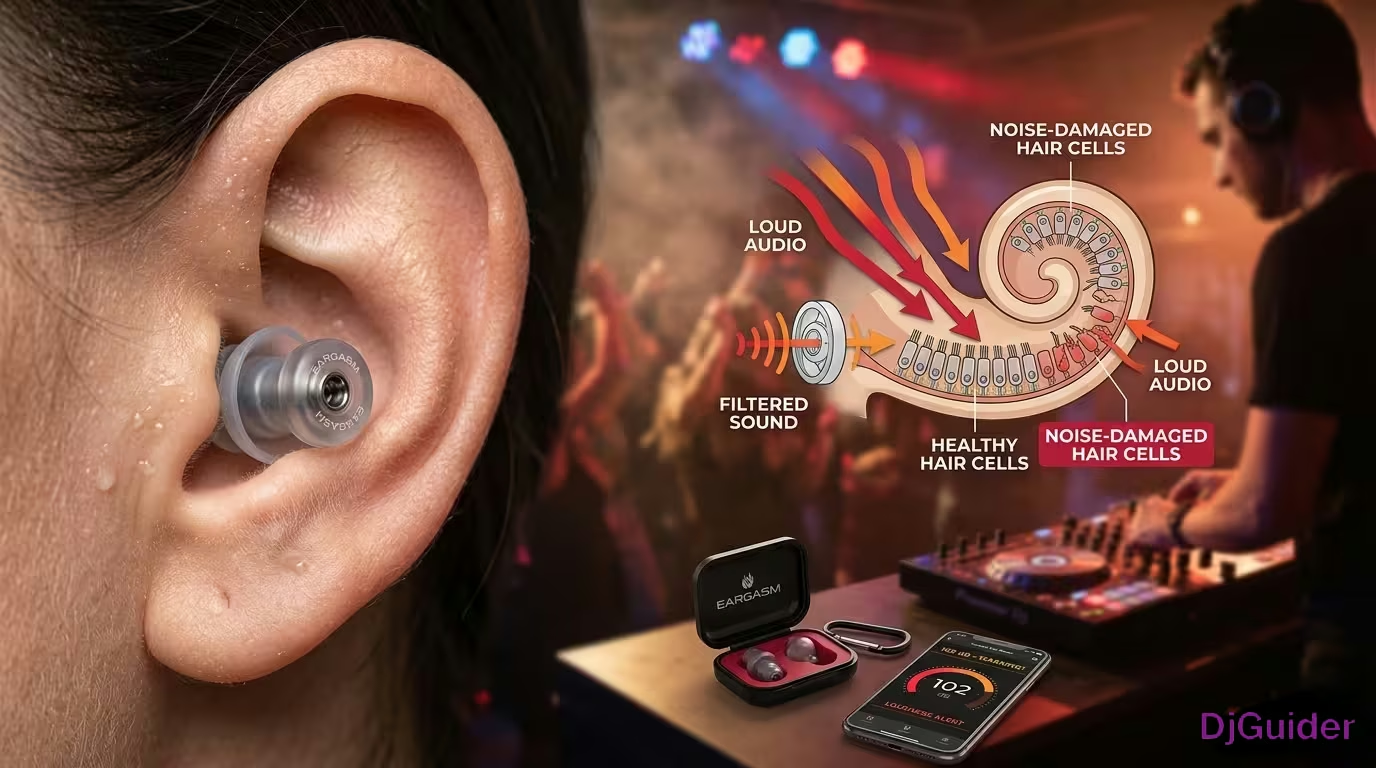
The average person is born with about 16,000 hair cells in the spiral cavity of the inner ear. These cells allow your brain to detect sounds.
If you go to a music festival or a club and the music's really loud, you may notice as you go to bed that night that your ears are ringing. What that actually means is the hair cells — they're usually straight — but extended exposure to loud noise causes them to bend, also known as short-term hearing damage.
They can straighten again after a period of recovery. However, if you continue to smash your ears — meaning repeat exposure to loud noises again and again, day after day — then over time this not only bends the hair cells but it could break and eventually kill them.
This mainly affects your ability to hear and understand speech over a period of time. Or perhaps you might get tinnitus, which is intermittent or continuous ringing in your ears.
- You're born with ~16,000 hair cells in your inner ear
- Loud noise bends these cells — short-term hearing damage
- They can recover with rest, but repeat exposure breaks and kills them
- Dead hair cells = permanent hearing loss
- Tinnitus: phantom ringing when the brain compensates for missing signals
The Key Signs of Hearing Loss DJs Should Watch For
The two clearest signs of hearing loss are trouble understanding speech in noisy places and ringing in your ears after loud events.
The first sign is having trouble understanding what people are saying in noisy places like restaurants and bars, or even struggling to understand what people are saying over the phone — saying things like "sorry, what was that?" or "can you speak up?"
However, the big one for DJs — and the one that's without a doubt the easiest to detect — is the ringing in your ears, which usually occurs after prolonged exposure to loud noise.
- Trouble understanding speech in noisy places or on the phone
- Ringing in your ears after loud events — the clearest signal that you've pushed your ears too far
How to Prevent Hearing Damage as a DJ
Repeat exposure to loud noise is the main culprit, and simply turning down the volume whenever you can is the most important thing you can do.
When researching this through various health, medical, and scientific sites, the one constant that always came up was the term repeat exposure to loud noise. So undoubtedly this is the main culprit.
If you're DJing every weekend then coming home and DJing more, and every single time you're either playing or listening to music you're smashing the volume — perhaps because you think that's the only way you can feel it — then over time, yeah, it's likely that you may damage your ears. That could mean ringing in your ears or perhaps not understanding some things people say.
So if you're concerned and you want to prevent possible hearing loss down the track, or you're already suffering from some hearing loss, my advice would simply be — just turn down the volume whenever you can. That means when you're playing for yourself at home or even researching music, just keep the volume at a moderate level.
The funny thing is, I do find volume to be a relative thing. If you start with the volume relatively quiet, your ears adapt to that volume, and then if you push it a little bit louder it kind of feels loud.
But here's the thing — when you start really loud and let's say your partner walks in and they're like "wow man, it's really loud in here," and let's say you turn it down just a little bit — even though your new volume is still much louder than the person before who started soft and turned it up — it might sound really quiet to you, but really it's only quiet in comparison to how loud you were previously playing.
If you start with the volume relatively quiet, your ears adapt to that volume, and then if you push it a little bit louder it kind of feels loud. Starting lower gives you more headroom and trains your ears to be satisfied with less.
So my advice: start lower than usual and let your ears adjust to the lower volumes. Then as you get into it you have a little bit more headroom to play with.
But if you do a session and your ears are ringing big after that, then listen to your body. By doing so you've learned your boundaries and what level is too loud. If you stayed at that level for an extended period of time it could cause short-term damage, and that means just be mindful to give your ears a bit of a break for a few days and give them a chance to recover.
How to Protect Your Ears When Playing or Attending Loud Venues
When the music is outside your control at venues and parties, you have several options to protect your hearing.
From a spectator's point of view, avoid standing right in front of the speakers. And if you really want to protect your ears, you should 100% look into some earplugs.
If you're actually playing at the event, the very first thing I would do is turn down the booth speaker. What I found is that DJs turn up into the DJ box and quite often the DJ is smashing the booth monitor — and that means the volume for the speakers in the DJ box.
Those speakers are usually facing you, you've got them pumping really loud, and they're right on you. DJs do it because they think they can feel it then, but what happens is it actually forces you to take your headphone volume up too.
If you're smashing speakers on you plus you've got your headphone volume smashing on you too — trust me, that's when you can do damage. Especially if you do that week after week after week.
DJs smash the booth monitor because they think they can feel it, but it forces headphone volume up too. Speakers facing you + loud headphones = dangerous combination week after week. If you can't control booth volume independently, face the speakers toward the crowd or turn them off.
So simply put — turn down the booth. And if the venue has the booth speakers set up on the same output as the master speakers, meaning you can't control the volume independently without affecting the volume in the room, perhaps turn the booth speakers off, or maybe even spin them around so they face the crowd and not you.
If you're a resident and you've got some influence at the events that you play, you may even be able to go into the venue during the week and ask if they can connect the booth speakers to the booth input so you can control the booth volume separately to the master room level.
But practical advice aside — without a doubt, if you're worried about your ears and you want to protect them, then wearing earplugs is honestly your best and your safest bet, as earplugs simply reduce the volume to a safe level.
The Three Types of Earplugs: Which Are Best for DJs?
There are three main types of earplugs, but for DJs, musician earplugs are the clear recommendation over cheap disposable options.
| Type | Cost | Sound Quality | Best For |
|---|---|---|---|
| Disposable foam earplugs | A few dollars | Poor — muffles highs, unbalanced sound | Emergency use only |
| Musician earplugs (universal fit) | Under $50 | Excellent — even frequency reduction | Most DJs, first step into protection |
| Musician earplugs (custom fit) | $150–$250+ | Excellent + perfect comfort | Professional DJs, long-term use |
| Full over-ear ear defenders | Varies | Extreme reduction | Construction — too much for DJs |
Disposable Foam Earplugs
The foam or disposable earplugs will definitely protect your ears, but they kind of degrade the sound quality. The cheaper earplugs don't reduce the frequencies of the track equally — they tend to reduce the high frequencies a lot more than the low frequencies, which can sound really strange to DJs.
This makes it really difficult when you play, especially when it comes to doing advanced EQ work, as you're going to be hearing the music a lot differently to how it was originally recorded. That's why people kind of hate the foam earplugs — especially musicians.
Musician Earplugs
Musician earplugs tend to reduce the volume or force of each frequency evenly, which means you're still hearing the track in the same way as recorded but you're essentially just reducing the volume, hence protecting your ears.
Unlike foam earplugs that muffle high frequencies, musician earplugs reduce each frequency evenly. You hear the track as it was recorded — just at a safer volume. Essential for DJs who need to hear hi-hats, snares, and EQ work clearly.
If you decide you do want musician earplugs — which really are the go — you have two main options: custom fit or universal fit.
Custom-made earplugs are more expensive. They require that you go to an ear specialist, they take a mold that's specially fitted to your ears, send it off, and then you get them back in a couple of weeks with a perfect fit.
Some of the custom earplugs even have removable filters, so you can decide how much you wish to reduce the volume. For instance, if you've got interchangeable filters, you could have different ones that take away different levels of sound. Let's say you're playing at a club and you just want to take the edge off slightly — you can get ones with a lower decibel, like maybe 5 decibels off, and that actually works well. But let's say you're in front of a speaker and you're getting smashed for hours — you might choose to put in a higher decibel one, something like 21 decibels, that takes off even more sound.
Universal fit musician earplugs essentially do the same thing as the custom fit ones, but because they're not customised to fit your ears they're going to be cheaper. They may not be as comfortable, but I'd say they're a good first step.
| Custom Filter | When to Use |
|---|---|
| 5 dB reduction | Playing at a club, just taking the edge off |
| 15 dB reduction | General club or festival attendance |
| 21 dB reduction | Standing near speakers for extended periods |
The Best Universal Fit Musician Earplugs: Brand Comparison
When it comes to the big brands of universal fit earplugs, Eargasm, Etymotic, Earasers, and EarPeace all come highly rated.
Eargasm seem to have the market monopoly, and a ton of people rate these as the best. They're quoted as saying they filter out a fair bit of the high end, but it's not too drastic, and it gives the listener a more natural listening experience.
Earasers boasted the flattest frequency of all earplugs, resulting in hardly noticing a difference in the sound at all. They say they reduce the frequencies that matter most and filter out the loud noise whilst also allowing you to hear music as it was supposed to be heard, but at a safer and more comfortable level.
Etymotic came up as a strong option too. Some people opted for these as they reduce the levels even more — probably at a higher decibel — and people felt safer with them.
- Eargasm — market leader, natural listening experience
- Earasers — flattest frequency response, minimal sound difference
- Etymotic — higher decibel reduction, stronger protection
- EarPeace — well rated, reasonably priced
- Most pairs under $50 — 100% a good start
| Brand | Key Notes | Best For |
|---|---|---|
| Eargasm | Filters high end but not too drastic, natural listening experience | Popular all-round choice |
| Earasers | Flattest frequency response, minimal difference in sound | DJs wanting least sound colouration |
| Etymotic | Reduces levels more than others, higher decibel protection | Those wanting stronger noise reduction |
| EarPeace | Well rated, reasonably priced | General DJ and musician use |
You could pick up a pair of any of these for under $50. If you find the universal fit uncomfortable, perhaps upgrade and get some custom fit earplugs down the track — but the universal fit is 100% a good start.
My Personal Approach to Protecting My Ears as a DJ
Here is the four-point strategy I use personally to protect my ears while still maximising the energy I feel when I DJ.
Number one — if I'm only playing for myself at home, I just don't pump it to a point that my neighbors would complain. As opposed to wearing earplugs at home — which, when you think about it, all they do is sort of reduce the volume — I find it easier to just not wear earplugs and seriously just keep the volume a little bit down. Trust me, I can still feel it without pushing the volume to a point that my ears are going to suffer.
By being moderate with the initial sound level I can play for hours on end without fear of doing any damage to my ears. And if you want to know whether or not you're doing damage — listen to your body. If your ears are ringing, that means you went too hard, too long.
If your ears are ringing, it's a sign that perhaps you should ease back for a few days. Next session, either don't go as loud or perhaps don't play as long. You need to start listening to your body and listening to the signs.
Number two — if my ears do ring after a session or an event, I try and go easy on my ears for a few days in order to give them the rest that they need, so hopefully the hair cells recover. It's kind of like fasting — you fast to give your digestive system a break.
Number three — if I'm playing live, I always turn down the booth speaker. If there are speakers connected to the master output and they're facing me and it's really loud, I do my best to point the speakers to the crowd. That's the big thing to be careful of in my opinion — loudspeakers really close, facing you.
Number four — in regards to wearing earplugs, I use common sense and intuition a lot. If I go to a club and it's really loud early and I notice that it feels too loud, I wear earplugs, as essentially all the earplugs are doing is reducing the volume to a comfortable level. But if the music's already at a comfortable level then I don't really need them.
I also find it easier to talk to people without earplugs, so I only really have them in my pocket on hand in case the system is too loud or if I find myself in front of a really loud speaker.
Personally I don't like wearing them when I play, but again — if I don't have control of the booth speakers and it's insanely loud, I'll 100% put on my earplugs. After my set I usually make it a rule to wear them for the end of the night or the second half of the night, especially if I've been at the venue for a few hours, as the big risk is being exposed to loud music for extended periods of time.
- Keep home practice volume moderate — start lower, let ears adjust
- Rest ears for a few days after ringing — like fasting for your hearing
- Always turn down the booth speaker or face it toward the crowd
- Carry earplugs at all times — wear them when the system is out of your control
Tinnitus, Lifestyle, and the Bigger Picture
Repeat exposure to loud noise is the main cause of tinnitus, but other lifestyle factors can significantly increase your risk.
When I researched tinnitus, that was one of the main culprits — repeat exposure to loud noise. But other things can contribute.
- Smokers have a higher risk of developing tinnitus
- Drinking alcohol also increases the risk
- Having high blood pressure can make you get it too
- Smoking — higher risk of developing tinnitus
- Alcohol — also increases risk
- High blood pressure — can contribute to onset
- Repeat loud noise exposure — the main culprit
- Taking care of your overall health reduces your risk
So all in all, if you take care of yourself and you be mindful of your body and your ears, you should be okay.
I played in bands when I was young and then DJed every single week for almost 20 years. I'll be honest — for the first 10 years I didn't wear earplugs, and perhaps that's going to come back to haunt me later in life. I remember quite often going to sleep and yeah, my ears were ringing after big events and parties.
But in saying that, I did always keep healthy during the week and never smash my ears during the week, and that probably gave my ears periods of recovery.
Remember — being sensible in regards to your ears means being mindful of exposure to loud noise. The longer you're exposed to loud noises, the greater the risk of damaging your ears. This could be short-term damage, but if repeated day after day and you don't give your ears a chance to recover, it may become more serious.
So if you're worried about it, get some earplugs. If the music's too loud and you have no control over the speaker levels and they're facing you — 100% wear earplugs, no doubt about it, even just for peace of mind.
But if you forget them one night and your ears are ringing — no need to freak out. Just be mindful in future and perhaps make a decision to try out some earplugs. I always carried mine, but in truth I only wore them when I knew it was too loud and I had no control over the volume.
If you're worried about it, get some earplugs. If the music's too loud and you have no control over the speaker levels and they're facing you — 100% wear earplugs. But if you forget them one night and your ears are ringing — no need to freak out. Just be mindful in future and give your ears time to recover.