Table of Contents▼
In This Article
- Why Reading the Room Is the Most Important DJ Skill
- How a Dance Floor Actually Works
- How to Scan the Room Before You Start
- The Two Types of People You'll Find in Any Crowd
- How to Figure Out Exactly What Your Crowd Wants
- What the Crowd Are Wearing
- The Age of the Crowd
- How People Respond to Your Music
- Recognise the Kind of Crowd You're Playing For
- Using Age Groups and Environment to Guide Your Music
- Going From a General Read to a Specific Read
- Why You Should Avoid Locking In a Planned Set
- The Moses Effect
- Pay Attention and Watch the Faces
- Manage the Energy With Purpose
- What to Do When the Crowd Gives You Nothing to Read
- The Formula: Strategic Adaptation
- Using Unexpected Sounds and Creative Music Choices
- How to Actually Approach DJing to a Crowd
- Other Factors to Consider When Reading a Crowd
- Crowd Size
- Alcohol
- The Pose Factor
- Attention Span
- Musical Knowledge
- Bring Enough Tracks
- Practising, Experimenting, and Not Letting Them See You Struggle
- Reading the Crowd: Complete Reference
Why Reading the Room Is the Most Important DJ Skill
Reading the room is probably one of the most important parts of your DJing career — and it has nothing to do with being technically perfect.
If you're DJing and you're just playing your favourite songs, you put together this great playlist of songs that you love that you've been practising all month, you show up to the party and you throw down that set and it's great — but the crowd isn't rocking with it.
When you don't pay any attention to your audience, the audience won't pay any attention to you. You have a sense of a disconnect when you're just stuck in your mixing and stuck in your music and just with your face glued onto your laptop, just making sure that you are technically proficient.
This is the part of DJing that isn't technical at all. This is the part of DJing where it's always going to be different, it's always going to be organic. And if you master it, you can create unforgettable experiences every single one that you do.
No matter what your set consists of, if you read the room properly you are always going to have a different party, and people are going to appreciate that. As an entertainment therapist, it's key for you to know how to read rooms — how to read people's energy, their body language, their verbal language, their dance skills, their posture, their everything.
Failure to read the crowd could lead to a certified disconnection between you and your crowd, and that will just kill your entire therapeutic process.
When you don't pay any attention to your audience, the audience won't pay any attention to you. The technical part of DJing is not as important as reading the room. You can be a bad DJ technically, but if you can read the room and play the proper songs, you'll get booked and you'll survive.
A DJ once said — I can't remember his name — but a DJ once said that DJing is like playing Tetris on level eight. When I heard that I was like, yo, he's absolutely right. Because there's a lot of pressure and a lot of things going on while you're DJing.
You've got to mix music, you've got to choose the next song coming up, you've got to beat match, you've got to entertain on the microphone, and you've got to read that room. Once you just understand the importance of all of them, it'll be natural.
There's a lot of pressure and a lot of things going on while you're DJing — you've got to mix music, choose the next song, beat match, entertain on the microphone, and read that room. Once you understand the importance of all of them, it'll be natural.
How a Dance Floor Actually Works
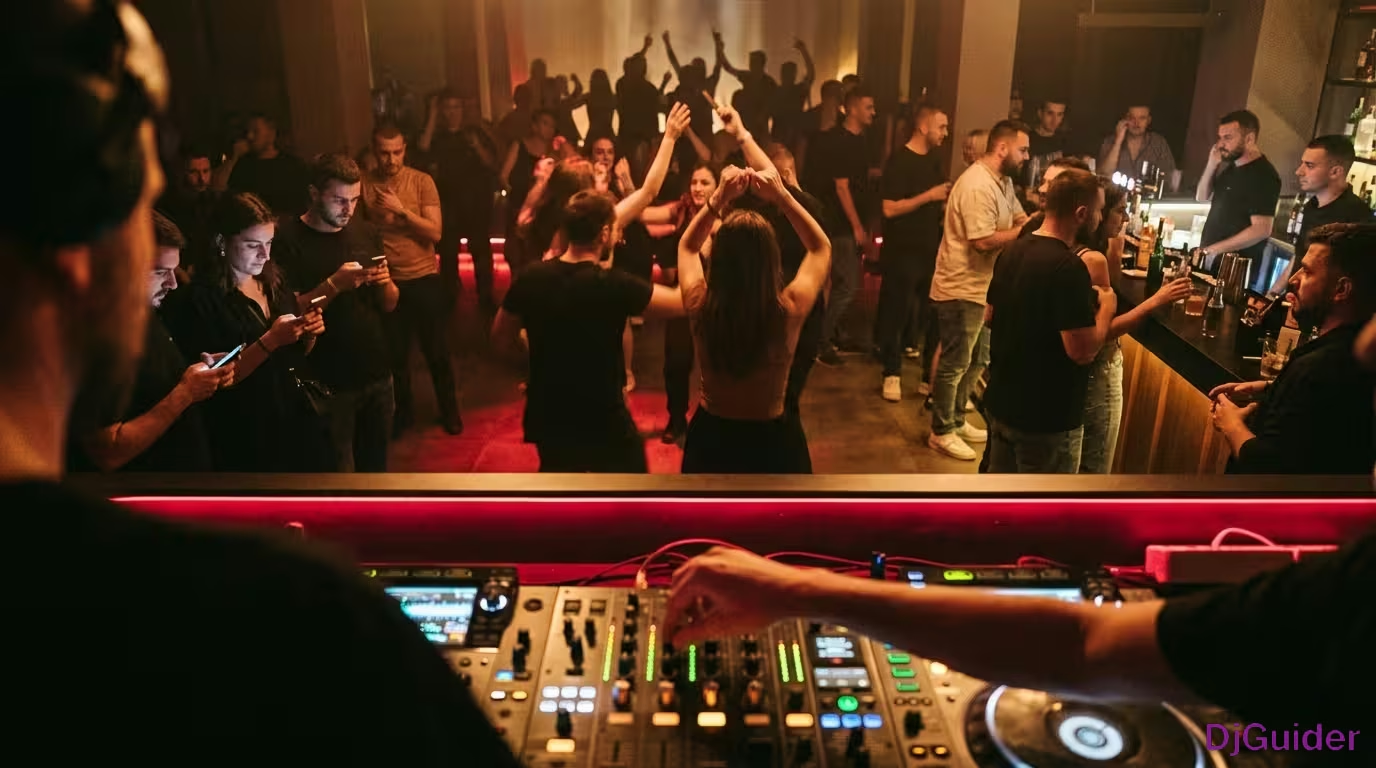
Think of the dance floor as a single person rather than focusing on individuals.
Ask yourself questions like: how much energy does it have? What kind of mood is it in? What is it there to do — is it there to get sweaty and rave, or is it there to pose for Instagram photos? How much has it had to drink?
Once you've considered the dance floor as an overall kind of being or person and you've sussed out what mood it's in and what direction it could be going, then you can start to focus your attention on the people within that room.
How to Scan the Room Before You Start
What I do to read the room is I always take a good scan before I even get started — because as the DJ, you are in control of the atmosphere, the energy, the mood, everything.
It's important that you don't rush it and that you take your time. You don't want to rush greatness. You don't rush a cook when he cooks a good meal for you, because anything rushed is never good. You want microwave breakfast or you want prepared breakfast? You know what I mean.
Take your time and look around the room and see what kind of people are there. Do we have more women than men? Do we have more men than women? Do we have groups of guys for a birthday party over here?
Do we have a group of women in their 30s over here, or a group of women in their 50s and 60s over here? You kind of want to just take these notes and make them in your own head and just scan the room and see what you're dealing with. Because those are the ingredients that you'll need to cook up a perfect event.
Don't be afraid to speak to some of these people, whether it's guests, a party planner, or the client. Getting to know them is going to better let you know what you're about to get yourself involved in.
Take your time and look around — age groups, gender mix, group types, energy baseline. Those are the ingredients you'll need to cook up a perfect event. Talk to guests, planners, or clients before you start.
| Pre-Scan Check | What to Look For |
|---|---|
| Age groups | 20s, 30s, 40s, 50s+ |
| Gender mix | More men or more women? |
| Group types | Birthday parties, corporate, club night? |
| Energy baseline | High energy or low key? |
| Environment | Inside, outside, venue type, country? |
The Two Types of People You'll Find in Any Crowd
Generally speaking, the majority of your crowd are going to be made up of what you'd call average people.
They're not particularly outgoing, but at the same time they're not particularly adverse to getting on the dance floor and having a dance. However, sprinkled amongst the mass you're going to have the party starters — the people that are going to be your best friend.
They are the little islands of energy that is infectious to other types of people. Think of the big group of girls celebrating a birthday or a hen party who haven't seen each other for ages — they're very excitable and they really just want to have a dance. You've also got the professional dancers that want to show off their moves, and the people that seem to know every single song that you're dropping.
On the flip side, you've got the people that stand on the side of the dance floor staring at their phone all night. Or even worse, they stand on your dance floor in a big group, their feet seem glued to the spot, and they're just chatting to each other or looking at their phone.
It's your job to either make them dance, or get the other people around them so excited and so hyped up that they feel really out of place — and then they go to the bar.
- Party starters — islands of infectious energy, your best friends in the room
- Average people — not particularly outgoing, not adverse to dancing
- Phone starers — glued to their phones, feet glued to the spot
- Your job — get the average people so hyped that the phone starers feel out of place and leave
How to Figure Out Exactly What Your Crowd Wants
Your mission is to learn enough about the crowd in front of you to pick the right records that will make them dance all night.
There are some obvious clues. First and foremost: what city are you in, what country are you in, and what type of venue are you playing in? An underground nightclub is going to have very different musical styles to that of a commercial high street nightclub.
What were they dancing to earlier, or last week, or on a previous night? If you don't know this because you've never played there before, speak to people. The bar staff are usually a good indicator because they're in that room all night. The door staff, the management team, or the DJ that played there before — reach out and ask what kind of stuff they were playing and what worked and what didn't.
If you are doing a private event or a birthday party, your meetings with the bride and groom or whoever is organising the event are going to be crucial. They can give you some key clues about the types of people attending.
What the Crowd Are Wearing
Another clue to figure out what they want is what the crowd are wearing. If you turn up to a venue where all the men are in suits and the ladies are in dresses and high heels, you could probably bet your bottom dollar they're not really up for raving until five o'clock in the morning to hardcore drum and bass or EDM.
Whereas people dressed more casually in jeans and trainers might be more up for some heavier styles of music.
The Age of the Crowd
The general age of the crowd is going to be a good indicator. A slightly older crowd might appreciate a few older songs. The newer stuff might be appreciated more by a younger crowd.
How People Respond to Your Music
Look at how people respond to your music specifically. If you notice people leaving the dance floor, what are you playing at that time, and which people are leaving? Similarly, when people arrive onto the floor, what are you playing at that time?
If you play a track that's getting people jumping up and down, what type of music are you playing? Be observant. Watch your crowd. The more you watch your crowd and the more songs you play, the more you are going to learn.
| Crowd Clue | What It Tells You |
|---|---|
| Dress code (suits and heels) | Not up for heavy raving |
| Dress code (jeans and trainers) | Open to heavier styles |
| Older crowd | Play more classic and throwback tracks |
| Younger crowd | Focus on new releases and current hits |
| People leaving the floor | Something isn't working — switch genres |
| People arriving on the floor | Something is working — lean into it |
Recognise the Kind of Crowd You're Playing For
You need to identify what taste of music your crowd is into before you can give them what they want.
Is it a young crowd? Is it an old crowd? Is it a ravy crowd? Is it a VIP crowd? There are all sorts of different crowds where you need to cater to your audience.
Even playing from country to country it can be different. Last night in America I played quite a bunch of trap. In Liverpool, UK, they absolutely hate trap, and if I would drop anything that sounds like dubstep, people would walk away.
In Brazil, for instance, they don't like anything that has to do with Samba or tribal drum-orientated music. That is their folklore music, and that is what their grandparents and parents listened to. When they go to a dance party, what they want to hear is straight-edged beats, and it's totally different than any other country in the world.
What works in one country can completely kill the energy in another. In Liverpool UK, crowds hate trap. In Brazil, they don't want tribal drum music at dance parties. Research local tastes, ask local DJs, and prepare accordingly.
Using Age Groups and Environment to Guide Your Music
If you know you have a group in a specific age group, that just narrows down the music that you're going to want to play.
You play a little top 40 here and there, but you also want to kind of play things that are from their time — things that are going to be nostalgic and going to resonate with them. There's no way that you'll know all the people you're DJing for exactly. You'll only know them to a certain extent.
Through the music and through the things you say on your microphone, you'll further get to know what these people like.
Environment is also a very important thing. Are you outside? Are you inside? Are you at Chuck-E-Cheese? Are you at the convention center? Are you in another country, another state, or on a boat?
These are all things that are important as well. Reading that and taking that information in is going to help you create the things that you're going to say and do for people and the music that you play. Because again, you're creating a full atmosphere based off the read you're taking from the room.
You want to look for movement pattern cues, facial expressions, and energy levels. Those things are going to let you know if you're reading them properly or if you're not.
Going From a General Read to a Specific Read
I like to start off with a general read of the room and just funnel it and narrow it down into more of a specific read.
If you know you have a birthday party, you start off by just shouting that person out. Once you shout that person out, you see who's the most excited person in the room when you do that shout-out — who's supporting the birthday guy or girl the most.
Now you can gauge that energy and that person's facial expression with the next piece of music that you want to play. If the person is a big-time dancer or has a big energy, that calls for those sorts of songs.
Why You Should Avoid Locking In a Planned Set
There's nothing wrong with preparing your sets musically, but once you lock in a system you really take away from being able to read the room.
If you're already stuck in a way that you planned on doing it, you're going to mess your process up. You're going to feel like, okay, if I don't play this mix properly they're not going to like it — but that's far from the truth.
You want to have an idea of what you want to play. It's like, okay, I know I'm doing a 40th birthday party, so I need to have some 90s, a little 80s, some top 40s, some of the new stuff, maybe a little 2010s stuff.
But you don't want to lock in a system. The technical part of DJing is not as important as the reading of the room. You can be a bad DJ, but if you can read the room and play the proper songs, you'll get booked and you'll survive.
You want to engage with these people and build a rapport. You want to create a sense of connection with all your guests.
It's okay to know you need 90s, 80s, top 40s, and throwbacks for a 40th birthday party. But don't lock in a song-by-song system. Stay flexible so you can read and respond in real time.
The Moses Effect
The Moses effect is when a packed crowd splits apart and you can see the dancefloor clearing out.
Just like Moses parted the sea, if it's a fully packed crowd and they start to split out, you can see dancefloor gaps appearing and people getting drinks. The trick while playing is to spot this early.
It's very obvious when they all walk away and you have an empty dancefloor. But watch for the earlier signs — if they're not engaging anymore, if the energy's not there, if they're not interacting with you.
The Moses Effect is when a packed crowd splits and the floor clears. The trick is to spot this early — before the floor is empty. If people are not engaging anymore, if the energy's not there, switch gears immediately.
Pay Attention and Watch the Faces
Watching your crowd's faces is the step that comes before the Moses effect hits.
Whenever I talk to the lighting guy just before I go on, I always tell him to brighten up the room a little bit so I can watch people's faces. Within that, you can still see if people are happy, if they're still engaged, if they're still having fun, if they're still into it.
What I always have in mind as well is that I want to be part of the party. I don't want to be the guy that's separated from the party. Together with the crowd, you make the party.
If I still feel like dancing, it's most likely the crowd will feel like dancing too.
I always tell the lighting guy to brighten up the room so I can watch people's faces. Within that, you can see if people are happy, engaged, and having fun. If I still feel like dancing, the crowd probably does too.
Manage the Energy With Purpose
Never let the energy become one big raging wall of dancefloor sound — momentum is what it's all about.
Never have the energy be like one big raging wall of dancefloor energy. That's cool, but at a certain point you'll lose your momentum. Momentum is what it's all about — creating the right moments, the right build-ups.
Not just in one track, but in a storyline you're trying to tell across your entire DJ set. If you give them less energy purposely, you can always come back with more.
With a diverse crowd, you have pockets of people and pockets of energy:
- People liking hits
- People liking underground stuff
- People liking new stuff
- People liking the stuff they already knew
- People liking your classics
How to tie all of this in is by getting back to energy and managing where you take the room.
Never let the energy be one big raging wall — you'll lose momentum. Create build-ups and release. Give them less energy purposely so you can always come back with more. Your set should tell a story.
What to Do When the Crowd Gives You Nothing to Read
There are times when the crowd really just isn't giving you much to read — they're just doing nothing, not much is going on.
You get boring crowds. You get people who are just chilling, just enjoying the energy, or they're just enjoying the weather, or they're just mundane. Sometimes that happens.
In those instances, you have to rely more on your creative instincts to create something for you to read. There's never really a time where you break this law — it's more that there are going to be a few times where nothing is happening in the room, nobody's giving you anything to read, and you've played countless songs and nothing's happening.
At those moments, you've got to tap into your own creative bag and create a moment. You can make a comment about the weather. You can make a comment about the location and the atmosphere of the location — something that everybody in general can relate to and can have an opinion on.
Because when you start with a general thing that everybody's aware of — if it's a company party and you say something like, "It's a great day to party with AT&T's Western Conference, I've heard a lot of great things about this group of people, so I'm excited to see what's to come for the rest of the evening" — you're able to provoke action out of the people who are giving you nothing.
Those would be the only times where you can't even apply the law. You've got to create the energy on your own. And that comes from bold choices and creative choices that you make as an experienced DJ.
Make a comment about the weather, the location, or the occasion — something everyone can relate to. This provokes a reaction from people who are giving you nothing. You've got to create the energy on your own.
The Formula: Strategic Adaptation
Reading the room is just a matter of finding a clean balance between your own instinctive choices and what the crowd is giving you — and putting the two together to create something from it.
You're going to want to practise strategic adaptation, and the way you do that is you read your crowd's emotional cues and you play music based off that. That's practically the formula. You observe, you play music, you see the reactions that come from it, and you either lean more into that genre and style of music or you switch gears into something else.
But ten times out of ten, the people are going to give you a reaction. It's just on you as to how far you'll scrutinise those reactions.
You have to observe their responses and take notes to see if the therapeutic atmosphere you're creating is effective or not.
| Step | Action |
|---|---|
| Observe | Read the crowd's emotional cues and energy |
| Play | Select music based on what you observe |
| React | Watch the response that comes from the music |
| Adapt | Lean into what works or switch gears entirely |
Using Unexpected Sounds and Creative Music Choices
You don't only have to play music that's on the radio and on Spotify — these are opportunities where you can embrace your creativeness.
You can express unique music and unique sounds that aren't necessarily a part of most DJ sets. For example, playing TV themes, or sounds that people are familiar with from commercials, or sound bites from social media — things like that to spark an emotion.
Like if you play the Fresh Prince of Bel-Air theme, somebody's going to rap that joint. And that's going to let you know who the rappers are, who the hype people are up in there. They'll give you what you want if you give them something to play with.
Remember, you are the entertainment therapist. You have the ability to touch these hearts and to make them do what you want them to do — in a good way. You are in charge of and have the power to make your guests party in any way you'd like them to party, as long as you have confidence and preparation.
- TV theme songs — Fresh Prince of Bel-Air lets you know who the hype people are
- Commercial sounds — familiar audio from ads sparks recognition
- Social media sound bites — taps into what's currently trending
- Your job — give them something to play with and they'll show you who they are
How to Actually Approach DJing to a Crowd
Make eye contact with people in the crowd — this is really, really important.
You will get a good sense of connection with your audience if you make eye contact with them. There is nothing worse than a DJ kind of looking around every now and then but really just focusing on what is beneath them the whole time.
This is particularly important at the start of the night when the crowd is pretty thin on the floor and you're just building it and shaping it into the night that you want it to be.
Finally, experiment — have a little bit of fun with your crowd. You don't want to end up being this really predictable DJ. Yes, the crowd might have gone mental to Bon Jovi's Living on a Prayer, but they might go even more crazy and give you an even bigger reaction when you drop a tech house surprise.
Never ever underestimate how your crowd might react to surprises and changes. And if it doesn't work out, at least you will know better for the next mix.
Other Factors to Consider When Reading a Crowd
Several additional factors will come into play that can dramatically affect how your crowd behaves.
Crowd Size
A smaller crowd is generally way more sensitive to change and very easy to throw off in comparison to a large crowd. If you've got a dance floor of only 50 people and five people leave, you're probably going to notice. Compare that to a dance floor of 1,000 people where 100 people leave.
Alcohol
There is nothing like a bit of alcohol to get the party started. However, do consider how drunk your crowd are, because generally speaking a crowd that is very drunk will burn out very, very quickly. Do consider how hard and fast you're playing your tunes.
The Pose Factor
Instagram is a big part of our life these days, and generally speaking there are going to be some people that go out to pose with the little champagne bottle or the vodka bottle. Or are the crowd there just to let their hair down and they don't really care so much about that?
Attention Span
This is really, really important in modern times. Nowadays anyone can flick through a million songs on Spotify, whereas before people probably had a little bit more attention when it came to music. Consider how quickly you're mixing through your tracks, or whether your crowd will tolerate you playing a whole track from end to end.
Musical Knowledge
Look for the people that are reacting to the brand new songs — they're pretty much clued up on things. Compare that to the amount of people that want the familiar, the well-known, and the classic rather than newer stuff.
| Factor | What to Look For | What It Tells You |
|---|---|---|
| Crowd size | 50 people vs. 1,000 people | Sensitivity to sudden changes |
| Alcohol level | How drunk the crowd appears | How long high energy will last |
| Pose factor | Champagne bottles vs. carefree dancing | Vibe and atmosphere expectations |
| Attention span | Quick reactions vs. settling in | How long to play each track |
| Musical knowledge | Reacting to new songs vs. classics | Balance of familiar and fresh |
Bring Enough Tracks
Simply put — bring enough tracks so you are flexible enough to cater to any crowd in any situation.
I bring about 3,500 tracks on my USB. With the four prior things in mind, make sure you stay really flexible and you'll be able to save yourself and keep catering to the crowd in any given situation.
Here are some concrete examples of how to apply this:
- Commercial crowd — play something by DJ Snake or Chainsmokers
- Underground crowd — give them plenty of stuff they don't know
- Young crowd — go for that festival vibe, play those EDM bangers, trap and dubstep
- Older crowd — keep it housey and play plenty of throwbacks
I bring about 3,500 tracks on my USB. This gives you the flexibility to cater to any crowd in any situation — from commercial to underground, young to old, any country, any genre.
Practising, Experimenting, and Not Letting Them See You Struggle
Reading the room is key — so remember to just take your head away from that laptop for a moment, scan the room, and look around at what you're dealing with.
Don't be afraid of your own creativity. There are going to be times where you come up with ideas and you try to do them on the fly, or you might practise them at home and then bring them out, and they might not resonate or work in the way that you anticipate. And that's okay.
Because you have to continue to keep trying those things. Fear is not going to work. Fear has never worked and it's never going to grow you as a DJ, and it definitely won't make you a better entertainment therapist.
These people are trusting us to supply them with the soundtrack of their life for that moment at least. So it's in your best interest to experiment as much as you can and take note of what works and fine-tune what needs a little work.
In order to do it, you've got to pay attention to the party and the people around you, the emotion that they're evoking, the energy they're at. And you need to mix that with your own unique creativity and find moments where it will work.
If it works, continue to fan the flame. If it doesn't, just adjust accordingly. And don't ever let them see you struggle — because you're the vibe curator, and the second that you're shaky and struggling, they will shake and struggle.
Continue to be this source of fun, this source of good energy, this source of therapeutic comfort. Remember that there are risks you have to take, so don't be afraid to take them. The bigger the risk, the better the reward.
Lean into that. Practice, practice, practice. Go out there, go to some clubs, go to some bars, and see how DJs are doing — or MCs, karaoke DJs, whatever it may be. Challenge yourself to ask, what would you do? What could you do? What would work? And see where it goes.
You're the vibe curator. The second you're shaky and struggling, they will shake and struggle. Continue to be this source of fun, good energy, and therapeutic comfort. The bigger the risk, the better the reward.
Reading the Crowd: Complete Reference
| Technique | What It Means | When to Apply It |
|---|---|---|
| Pre-set room scan | Identify age groups, gender mix, and crowd type | Before you even play your first track |
| Recognise crowd type | Identify age, taste, and cultural background | Before you select your first song |
| Birthday shout-out gauge | See who reacts most to find your hype people | Early in the night to narrow your read |
| Movement and facial cue watch | Track energy levels, dance patterns, expressions | Throughout your entire set |
| The Moses Effect | Spot when the crowd splits and the floor clears | Mid-set when engagement drops |
| Environment read | Factor in venue type, country, indoor/outdoor | Shaping atmosphere and mic commentary |
| General crowd comment | Make a relatable comment to provoke reaction | When the crowd gives you nothing |
| Unexpected sounds | Play TV themes, commercial sounds, social media clips | Sparking emotion and finding your crowd |
| Avoid locked-in sets | Keep a genre plan but don't script song-by-song | Staying flexible to read in real time |
| Manage the energy | Give less so you can come back with more | When momentum starts to flatten |
| Bring enough tracks | 3,500 tracks for any crowd situation | Preparation before every show |
| Strategic adaptation | Observe, play, react, adapt | The core formula for the whole night |