Table of Contents▼
In This Article
- Why Reading the Room Is the Most Important Skill in DJing
- How to Scan the Room Before You Even Start
- Movement Cues, Facial Expressions, and Energy Levels
- How to Funnel a General Read Into a Specific One
- Why You Should Avoid Locking Into Pre-Planned Sets
- What to Do When the Crowd Gives You Nothing to Read
- Strategic Adaptation: The Formula for Reading Emotional Cues
- Using Unique Sounds and Surprises to Spark a Reaction
- Don't Let Them See You Struggle
- Reading the Room: Key Methods Summary
Why Reading the Room Is the Most Important Skill in DJing
Reading the room is probably one of the most important parts of your DJing career — and it has nothing to do with technical skill.
When you don't pay any attention to your audience, the audience won't pay any attention to you. You have a sense of a disconnect when you're just stuck in your mixing and stuck in your music, with your face glued onto your laptop just making sure that you are technically proficient.
This is the part of DJing that isn't technical at all. This is the part of DJing where it's always going to be different, it's always going to be organic. If you master it, you can create unforgettable experiences every single one that you do.
No matter what your set consists of, if you read the room properly you are always going to have a different party and people are going to appreciate that. As an entertainment therapist, it's key for you to know how to read rooms, how to read people's energy, their body language, their verbal language, their dance skills, their posture, their everything.
- People's energy levels
- Body language and posture
- Verbal language and reactions
- Dance skills and movement patterns
- Everything — the full picture
Failure to read the crowd could lead to a certified disconnection between you and your crowd. And that will just kill your entire therapeutic process.
A DJ once said that DJing is like playing Tetris on level eight. When I heard that I was like, yo, he's absolutely right. There's a lot of pressure and a lot of things going on while you're DJing. You've got to mix music, choose the next song, beat match, entertain on the microphone, and read that room. Once you just understand the importance of all of them, it'll be natural.
How to Scan the Room Before You Even Start
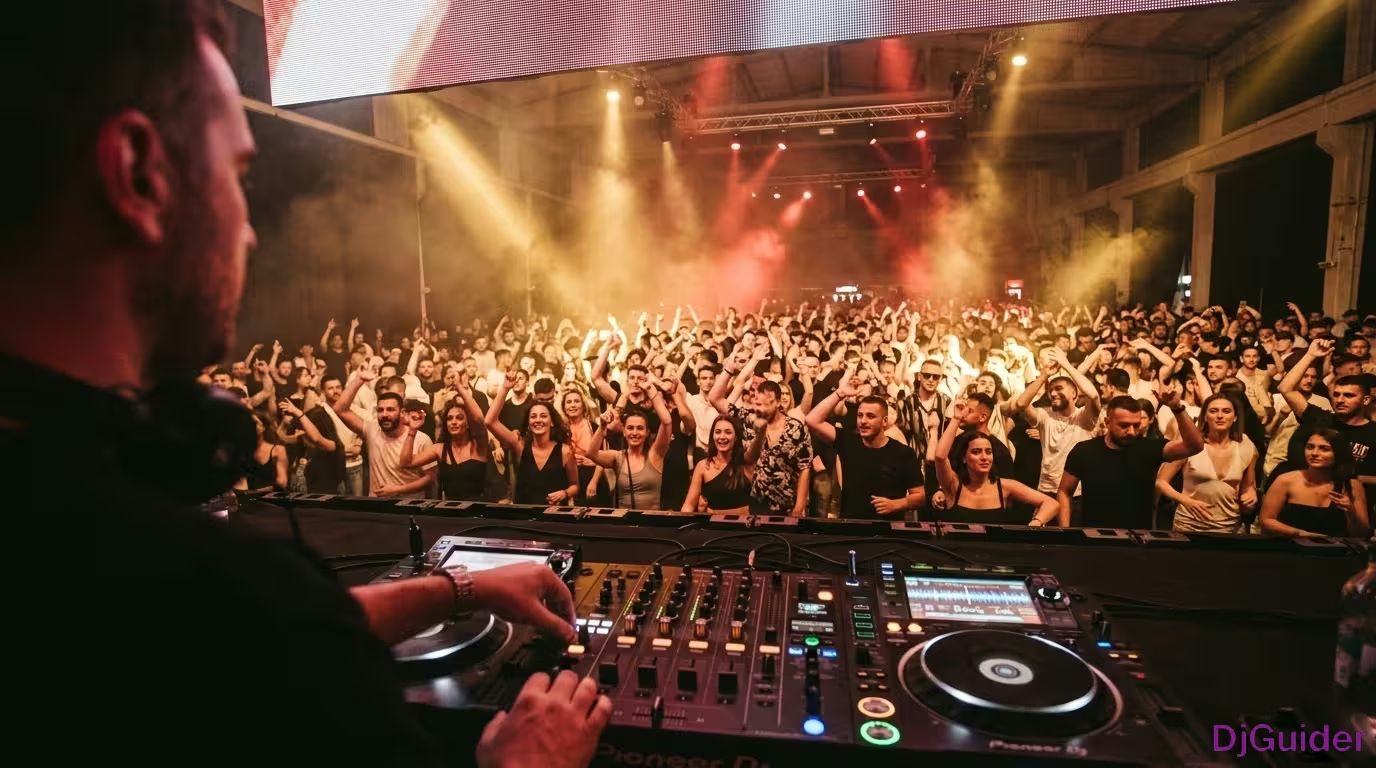
Always take a good scan of the room before you even get started, because as the DJ you are in control of the atmosphere, the energy, the mood of everything.
You don't want to rush greatness. You don't rush a cook when he cooks a good meal for you, because anything rushed is never good. You want microwave breakfast or you want prepared breakfast?
Take your time and look around the room and see what kind of people are there. What kind of groups of people are there? Do we have more women than men? Do we have groups of guys for a birthday party over here? Do we have a group of women in their 30s over here, or a group of women in their 50s and 60s over here?
You want to take these notes, make them in your own head, and just scan the room and see what you're dealing with. Because those are the ingredients that you'll need to cook up a perfect event.
Don't be afraid to speak to some of these people, whether it's guests, a party planner, or the client. Getting to know them is going to better let you know what you're about to get yourself involved in.
| Scan Check | What to Look For |
|---|---|
| Age groups | Are they 20s, 30s, 40s, 50s+? |
| Gender mix | More men or more women? |
| Group types | Birthday parties, corporate, nightclub? |
| Energy baseline | High energy or low key? |
If you know you have a group in a specific age group, that just narrows down the music that you're going to want to play. You play a little top 40 here and there, but you also want to play things that are from their time — that's going to be nostalgic and it's going to resonate with them.
Movement Cues, Facial Expressions, and Energy Levels
Movement pattern cues, facial expressions, and energy levels are going to let you know if you're reading the room properly or if you're not.
Environment is also a very important thing. Are you outside? Are you inside? Are you at Chuck-E-Cheese? Are you at the convention center? Are you in another country, another state, or on a boat?
Reading that and taking that information in is going to help you create the things you're going to say and do for people, and the music that you play. Because again, you're creating a full atmosphere based off the read you're giving — or the read you're taking — from the room.
How to Funnel a General Read Into a Specific One
Start off with a general read of the room, then funnel it and narrow it down into a more specific read.
If you have a birthday party, you start off by shouting that person out. Then once you shout that person out, you see who's the most excited person in the room. Who's supporting the birthday guy or girl the most?
Now you can gauge that person's facial expression with the next piece of music you want to play. If the person is a big-time dancer or has big energy, that calls for those sorts of songs in those situations.
Why You Should Avoid Locking Into Pre-Planned Sets
Plenty of DJs will sit home and plan exactly what they're going to play — but once you lock into a system, you really take away from being able to read the room.
There's nothing wrong with preparing your sets musically. It's okay to say, I know I'm doing a 40th birthday party so I need some 90s, a little 80s, some top 40s, some new stuff, maybe a little 2010 stuff.
But you don't want to lock in a system. Because then you're going to feel like if you don't play that mix properly, they're not going to like it — and that's far from the truth.
But you don't want to lock in a system. Because then you're going to feel like if you don't play that mix properly, they're not going to like it — and that's far from the truth.
The technical part of DJing is not as important as the reading of the room. You can be a bad DJ, but if you can read the room and play the proper songs, you'll get booked and you'll survive.
What to Do When the Crowd Gives You Nothing to Read
There are times when the crowd really just isn't giving you much to read — they're just doing nothing, not much is going on.
You get boring crowds. You get people who are just chilling, just enjoying the energy, or just enjoying the weather. Sometimes that happens, and in those instances you have to rely more on your creative instincts to create something for you to read.
There's never really a time where you break this law, but there are going to be a few times where nothing is happening in the room. Nobody's giving you anything to read from, and you've played countless songs and nothing's happening.
At those moments, you've got to tap into your own creative bag and create a moment. You can make a comment about the weather, or make a comment about the location and atmosphere of the venue — something that everybody in general can relate to and can have an opinion on.
If it's a company party, you say something like, it's a great day to party with AT&T's Western Conference — I've heard a lot of great things about this group of people, so I'm excited to see what's to come for the rest of the evening. You're able to provoke action out of the people who are giving you nothing.
Those would be the only times where it's more or less not that you break the law, but that you can't even apply it. You've got to create the energy on your own. And that comes from bold choices and creative choices that you make as an experienced DJ.
Strategic Adaptation: The Formula for Reading Emotional Cues
Reading the room is just a matter of finding a clean balance between your own instinctive choices and what the crowd is giving you — and putting the two together.
You want to practice strategic adaptation, and the way you do that is you read your crowd's emotional cues and you play music based off that. That's practically the formula.
You observe, you play music, you see the reactions that come from it, and you either lean more into that genre and style of music or you switch gears into something else. 10 times out of 10, the people are going to give you a reaction. It's just on you as to how far you'll scrutinize those reactions.
You have to observe their responses and take notes to see if the therapeutic atmosphere you're creating is effective or not.
| Step | Action |
|---|---|
| Observe | Read the crowd's emotional cues and energy |
| Play | Select music based on what you observe |
| React | Watch the response that comes from the music |
| Adapt | Lean into what works or switch gears entirely |
Using Unique Sounds and Surprises to Spark a Reaction
You don't only have to play music that's on the radio and on Spotify — these are opportunities to express unique music and sounds that aren't necessarily a part of most DJ sets.
You can embrace your creativeness by playing TV themes, sounds that people are familiar with from commercials, or sound bites from social media. Things like that spark an emotion.
For example, if you play the Fresh Prince of Bel-Air theme, somebody's going to rap that joint. And that's going to let you know who the hip-hop heads are up in here. They'll give you what you want if you give them something to play with.
- TV theme songs (e.g. Fresh Prince of Bel-Air)
- Sounds from commercials
- Sound bites from social media
- Nostalgic audio from specific eras
Remember, you are the entertainment therapist. You have the ability to touch these hearts and make them do what you want them to do — in a good way. You are in charge of and have the power to make your guests party in any way you'd like them to party, as long as you have confidence and preparation.
Don't Let Them See You Struggle
Reading the room is very important to the growth of the energy of the party — so remember to just take your head away from that laptop, scan the room, and look around at what you're dealing with.
Don't be afraid of your own creativity. There are going to be times where you come up with ideas and try them on the fly, or you practice them at home and bring them out and they might not resonate or work in the way you anticipated. And that's okay.
You have to continue to keep trying those things, because fear is not going to work. Fear has never worked and it's never going to grow you as a DJ, and it definitely won't make you a better entertainment therapist.
These people are trusting us to supply them with the soundtrack of their life, at least for that moment. So it's in your best interest to experiment as much as you can, take note of what works, and fine-tune what needs a little work.
Don't ever let them see you struggle. Because you're the vibe curator, and the second that you're shaky and struggling, they will shake and struggle. Continue to be this source of fun and this source of good energy and this source of just therapeutic comfort.
The bigger the risk, the better the reward. So lean into that. Practice, practice, practice.
You have to continue to keep trying those things, because fear is not going to work. Fear has never worked and it's never going to grow you as a DJ, and it definitely won't make you a better entertainment therapist.
Reading the Room: Key Methods Summary
| Method | What to Do | Why It Works |
|---|---|---|
| Pre-event scan | Observe age groups, gender mix, and crowd energy before starting | Gives you the ingredients to cook up a perfect event |
| Talk to guests and clients | Speak to party planners, clients, or attendees early | Narrows down the music and lets you know what you're getting into |
| Shout-out technique | Shout out the guest of honour and watch reactions | Reveals your most energetic crowd members to gauge from |
| Avoid locked-in sets | Have a genre direction but no fixed tracklist | Keeps you flexible to respond to what the room is giving |
| Create energy from nothing | Use comments about location, weather, or the occasion | Provokes a reaction when the crowd is giving you nothing |
| Strategic adaptation | Observe, play, watch reactions, adjust genre or energy | The core formula for reading emotional cues in real time |
| Surprise sounds and themes | Play TV themes, sound bites, or social media audio | Sparks unexpected emotional reactions and reveals crowd personality |