
Table of Contents▼
In This Article
- The History and Background
- Design and Build Quality
- Workflow and Software Ecosystem
- Practical Features and Performance
- Reliability: The Most Important Factor
- The Apple vs Android Analogy
- Price Comparison
- Pioneer vs Denon: Which DJ Should Buy Which
- What They Have in Common
- Design and Build
- XDJ-AZ Exclusive Features
- Opus Quad Exclusive Features
- Which One Should You Choose?
- Pioneer vs Denon: Full Brand Comparison
- XDJ-AZ vs Opus Quad: Full Comparison Table
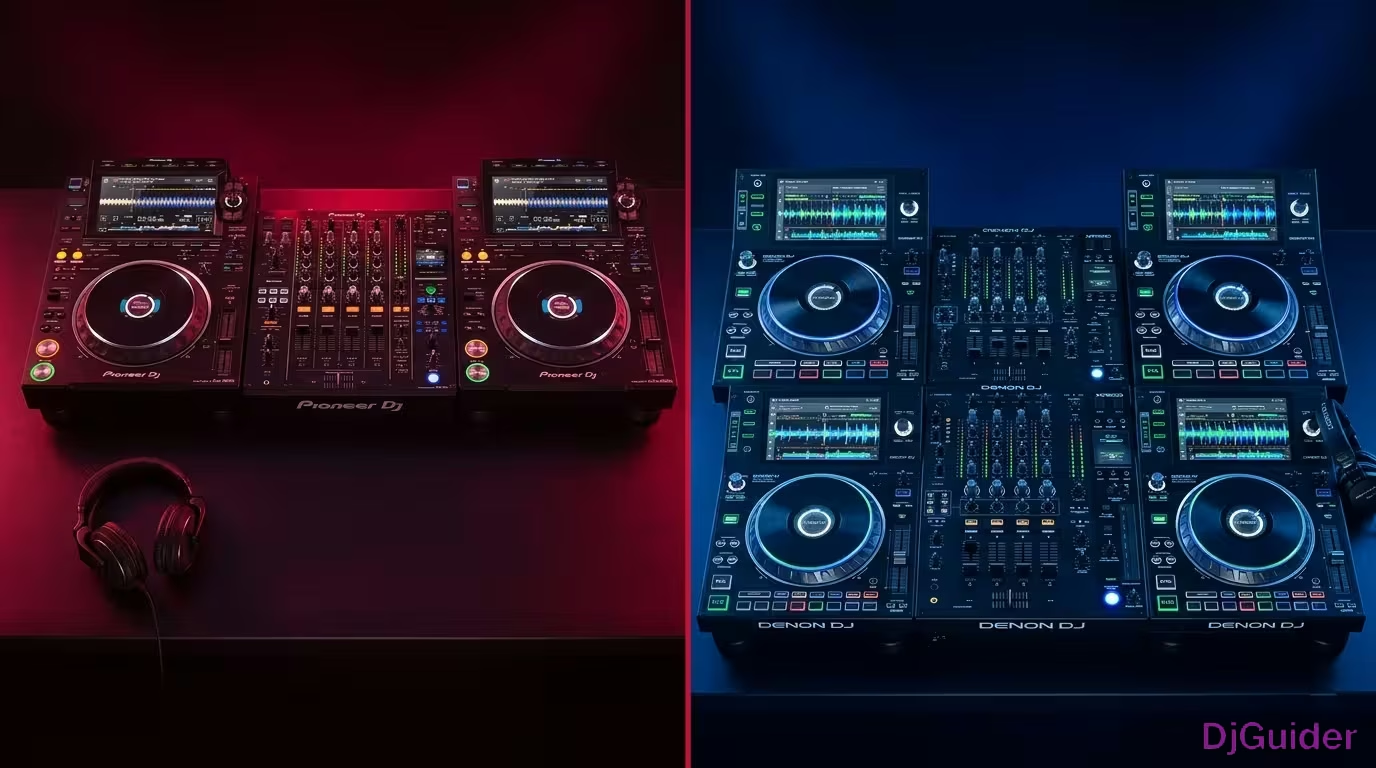
Pioneer (Alpha Theta) is the industry standard for clubs worldwide — extreme reliability, consistent workflow, and ecosystem compatibility. Denon offers fantastic products at a fraction of the price with more features and streaming support, but has historically struggled with stability and USB load times. Within the Pioneer lineup, the XDJ-AZ is built for club-style DJs with CDJ-3000 jog wheels and ProDJ Link, while the Opus Quad targets mobile DJs with Zone output and a striking curved design. Choose based on your context: clubs = Pioneer, home/mobile = Denon or Pioneer depending on budget.
The debate between Pioneer and Denon is one of the most polarising conversations in the DJ world. Ask ten DJs which brand is better and you'll get ten different answers — each one heavily influenced by their own context, workflow, and personal experience.
Then within the Pioneer lineup itself, there's another debate entirely: the XDJ-AZ vs the Opus Quad. Two four-channel standalone systems from the same company, built for two very different types of DJ.
This guide covers both conversations. First, the brand-level comparison: Pioneer vs Denon, covering history, build quality, workflow, reliability, and price. Then, the model-level comparison: XDJ-AZ vs Opus Quad, a deep dive into features, screens, outputs, and which one to buy.
Let's start with the big picture.
The History and Background
Pioneer, now commonly known as Alpha Theta, has historically been the standard in clubs and festivals. Denon makes fantastic products at a fraction of the price. But the right choice depends entirely on your context.
You will never find equipment that's different from Pioneer except in rare cases with some DJs. For example, Tiësto literally uses Denon consoles because he gets paid a ton of money to put Denon in a good light.
That said, and without taking anything away from this brand, Denon makes fantastic products at a fraction of the price compared to its competitor, Pioneer. There are some caveats, though.
When it comes down to it, the Pioneer CDJ series is everywhere, and it is used mainly in professional settings. It is literally seen as today's benchmark for anyone who needs to be cloud ready.
Denon, on the other hand, presents itself as an alternative and above all innovative player. I absolutely do not question the fact that Denon is doing amazing things at incredibly low prices.
Certainly in recent years with the SC6000, the Prime 4, or the Prime 4 Plus, Denon has really gained a lot of ground.
Pro tip: Understanding the history matters because it explains the ecosystem lock-in. Pioneer has spent 15+ years embedding itself in clubs worldwide. Denon has spent those years innovating on features and price. Neither approach is wrong — they just serve different DJs.
Design and Build Quality
The build quality difference between Pioneer and Denon is real, and it's one of the biggest factors separating them.
We're talking about top tier products here, not controllers that cost €200, €400, or €600, but things like the CDJ-2000, CDJ-3000, and so on. The same goes for Denon.
The build quality of a Pioneer product, and guys, don't take it the wrong way, but it's miles ahead. Even just the responsiveness you get from the controls on a Pioneer CDJ or a Pioneer compact unit — there's no comparison with any Denon product.
It's no coincidence that it's a professional product used in clubs all over the world. On the other hand, Denon, especially with the SC6000, which is a truly solid and high-performing CDJ, comes at a ridiculously low price compared to its Pioneer competitor.
The SC6000 is often praised for its touchscreen and for the large control surface it offers. Some users actually prefer its interface. Denon's Engine DJ software is preferred for certain operations like managing the library or triggering certain effects or samples.
Many user reviews available online frequently praise one particular brand over another based entirely on their own individual workflow and personal preferences. Therefore, we cannot truly consider these to be objective reviews, but rather highly subjective ones that are heavily dependent upon your unique and personal style.
Workflow and Software Ecosystem
Pioneer and Denon take very different approaches to how DJs interact with their software and hardware.
Pioneer, after more than 15 years in clubs, now has a well-established workflow with Rekordbox, Pioneer's proprietary software or Alpha Theta. This ensures a consistent experience between the studio and the club.
Many features are also designed for integration with Pioneer's own mixer, making it a sort of ecosystem. We could almost say that Pioneer and Denon are a bit like Apple and Android.
On the other hand, Denon really focuses on innovation. Thousands of features, thousands of buttons, and thousands of extra things that, unfortunately, I'm sorry to say, don't always do good.
Despite Denon DJ's very dynamic interface, support for streaming, and the ability to play high-quality tracks from Beatport or even Spotify in lossless mode, in a professional context, Denon unfortunately still lags a step behind.
Rekordbox is very widespread and maintains compatibility with all clubs. Many services and features at the pro level revolve around Rekordbox.
Denon's Engine DJ software has seen exponential growth in recent years and now also offers conversions, imports, and integrations. Although some DJs and users report the need to pay for a subscription in order to achieve perfect synchronisation through their media library on PC and CDJ.
Practical Features and Performance
Both platforms have excellent algorithms, but they each have clear strengths in different areas.
Some opinions found online mention that the time stretching, Denon's algorithm, and the display, ensure the grid and how the track is visualised are done excellently compared to Pioneer, which perhaps lags a bit behind from a visual standpoint, user experience, or even customisation.
On the other hand, Pioneer is often praised for the responsiveness of the machine itself. From the jog wheel to the cue buttons, and above all, for the stability of the product itself.
A Pioneer machine — it is really, really difficult for it to freeze during a live set. And this is basically the reason why you find the Pioneer brand in clubs and not Denon.
Reliability: The Most Important Factor
Reliability is where the gap between Pioneer and Denon is most clear, and most consequential.
Because believe me guys, I organise events and I know a lot of club owners, and I can tell you one thing — wherever it's possible to save money, they will. But when it comes to the console, to the equipment the DJ needs, which is literally the soul of the party, literally the reason a club stays open, you just can't cut corners.
I've played on CDJ-2000s that are something like 14 years old, 12 years old, something like that. They run basically like a Fiat 600. They start up on the first try.
The collective view in the DJ world is pretty clear. Pioneer is the standard and is used in clubs. Denon is like a kid who's growing up fast, basically.
However, in recent times, Denon has significantly improved the stability of its software. But when it comes down to it, and it pains me to say this, Denon is not stable software.
It happened to me on two occasions when I used Denon consoles. And in one of those, the CDJ SC6000 froze, guys. It literally froze. Luckily, the music was playing from somewhere else at that moment.
Pro tip: The USB load time difference alone is a dealbreaker in professional settings. A Rekordbox-analysed USB loads on a Pioneer CDJ in 5–6 seconds. The same USB in a Denon CDJ can take minutes. In a club or festival environment, that's simply not workable.
The Apple vs Android Analogy
Pioneer is like Apple. Denon is like Android. That comparison explains almost everything.
Over the years, Pioneer has built its own ecosystem in which all the feedback from professional DJs is integrated step by step as the brand evolves.
I have a USB drive with my tracks analysed by Rekordbox, which I insert into my Pioneer CDJ, and within 5 to 6 seconds, I'm ready to browse my library, select a track, load it onto the deck, and start playing.
But when I insert my USB drive into a Denon CDJ, whether it's MP3 files, files analysed by Engine, or even files analysed by Rekordbox itself, it takes minutes, guys. Literally minutes before I can access my tracks.
So you can clearly understand that this is something that in a club or professional context, or even in a festival setting, this just can't work. I can't wait 10 minutes for my USB stick to be read by a CDJ.
Price Comparison
The price gap between Pioneer and Denon is significant, and it's one of the most common reasons people choose Denon.
An SC6000 costs around €600, €700, €800, while you can't find a CDJ-3000 for less than €2,400.
It's true, the price is really inflated, especially because of the brand. But this price actually makes sense, and it's precisely because of this reliability, being able to count on your equipment.
| Product | Approximate Price | Key Strength |
|---|---|---|
| Denon SC6000 | €600–€800 | Features, touchscreen, value |
| Pioneer CDJ-3000 | €2,400+ | Stability, club standard, ecosystem |
| Pioneer CDJ-350 (used pair) | €300–€400 | Budget entry for club training |
| Pioneer XDJ-RX3 | ~€2,000 | All-in-one for events and guests |
Pioneer vs Denon: Which DJ Should Buy Which
The right choice between Pioneer and Denon comes down entirely to the context in which you need to use it.
If you're playing at home, if you're the kind of DJ who does birthday parties or weddings, or if you're a DJ who brings your own gear to the club, in that case, I strongly recommend buying Denon. Not because of reliability or anything like that, but because you'll save a ton of money.
But if you're a DJ who's aiming to do club gigs, seriously, to become a resident or something like that — believe me, two CDJ-350s which cost €300 to €400 used for the pair are a thousand times better than any modern Denon CDJ.
First of all, because you learn to use a Pioneer CDJ with all the methods and functions specific to Pioneer. So when you find yourself in a club with a Pioneer console, you'll already know exactly what to do.
Denon, for example, uses a different method just to save a cue point. So when you eventually end up on a Pioneer console, say the day you get called to play at a club, you'll have to spend some time figuring things out.
If you want a professional context, or if you're an event organiser like I am, you absolutely can't afford to have a DJ you invite to your event play on anything other than Pioneer products because that's the industry standard.
The reason I spent €2,000 to get my Pioneer XDJ-RX3 is because I know that anyone I invite to play will be perfectly happy with the RX3. If I have to invite an artist though, of course, I'll rent a mixer — whether it's Pioneer or Allen & Heath — plus CDJ-3000s, but always Pioneer.
If you're a DJ who does weddings or these kinds of parties, Denon is miles ahead. You have thousands more features. It's convenient. You can use streaming services. If the audience requests a song and you don't have it downloaded, you can stream it and play it live. That's really cool from that point of view, in that context, for that type of DJ.
But if you're a club DJ, it's Pioneer. End of story.
XDJ-AZ vs Opus Quad: Deep Dive Comparison
Now let's zoom in on two of the biggest standalone controllers within the Pioneer lineup — the XDJ-AZ and the Opus Quad. Both made by the same company (Alpha Theta / Pioneer DJ), both four-channel, both work with Rekordbox and Serato. But they are built for two very different types of DJ.
The XDJ-AZ is a lot more like the industry club standard CDJ and mixer setup you would expect to see in a nightclub. It's the XDJ-XZ on steroids — a shrunken version of an A9 mixer and two CDJ-3000 multiplayers all put into one box, selling for way under half the price of that separate setup.
The Opus Quad is more akin to the professional DJ who still wants the usability and functionality of an all-in-one console but isn't really tied to the CDJ world. It's a high-end mobile DJ device — something that looks visually stunning and very different from the classic DJ gear look.
What They Have in Common
Both work with Rekordbox and Serato. Both have USB-C output for your laptop. Both have Bluetooth input as a backup option. Both can connect to Cloud Direct Play for accessing your library over the internet. Neither handles MP4 video files natively on its own screens.
Design and Build
The XDJ-AZ looks and feels like club gear. The jog wheels are the exact same jog wheels that you get on the CDJ-3000s — a major selling point. The Opus Quad has a striking curved design with wood effect around the edges, orange and white colour accents, separate small screens above each jog wheel showing symbolic information, and a central touchscreen for track data and artwork.
Pro tip: When either unit is on a suitable DJ setup, 99% of the public won't know or care which one it is. So long as the DJ is doing a good job playing good music, they don't care what gear you're using.
XDJ-AZ Exclusive Features
- Wireless Headphones via Sonic Link — supports the HDJ-F10 with automatic connection. The jury is still out on wireless latency for beatmatching by ear.
- ProDJ Link for External Multiplayers — can connect up to two CDJ-3000s to control decks three and four. Not possible on the Opus Quad.
- Beatport Streaming — available as a selectable source. Not available on the Opus Quad at the time of recording.
- Gate Cue Mode — cues work like most DJ controllers (play from cue if playing, pause at cue if paused). Not available on the Opus Quad.
- Expanded Effects — more effects including the triplet roll, with low/mid/high channel splitting like standalone club mixers.
- Four separate load buttons — one per channel, giving clear visual feedback on what you're loading where.
Opus Quad Exclusive Features
- Zone Output for Mobile DJs — a separate XLR output that lets you play different music in a second room. Excellent for weddings and multi-room events.
- XY Pad for Beat Effects — fun control of a combination of filter and effect that isn't available on the AZ.
- Built-In Smooth Echo — easier to trigger smoothly than a similar effect on the AZ.
- Hot cues positioned above jog wheels — more like the CDJ-3000 layout, though they only do cues and loops here.
- Three screens — central touchscreen plus two jog wheel screens for symbolic track information.
- Front and rear mic inputs — more convenient for mobile DJ setups.
Which One Should You Choose?
Both units are the same price. If you're a mobile DJ doing weddings and multi-room events, the Opus Quad's Zone output and striking design make it the better choice. If you're a club-style mixing DJ who wants tactile functionality, CDJ-3000 jog wheels, ProDJ Link for external decks, Beatport streaming, and Gate Cue mode, the XDJ-AZ is the stronger option.
The XDJ-AZ is the newer of the two units, so it makes more sense if you're trying to future-proof your purchase.
Pioneer vs Denon: Full Brand Comparison
| Pioneer | Denon | |
|---|---|---|
| Club Standard | Yes — industry standard worldwide | No — still growing |
| Build Quality | Miles ahead | Solid, especially SC6000 |
| Software | Rekordbox — stable, widely compatible | Engine DJ — innovative but subscription needed |
| USB Load Time | 5–6 seconds | Several minutes |
| Stability | Extremely reliable, rarely freezes | Has frozen during live sets |
| Price | €2,400+ for CDJ-3000 | €600–€800 for SC6000 |
| Best For | Club DJs, residents, event organisers | Home DJs, weddings, mobile DJs |
| Innovation | Incremental, ecosystem-focused | Fast-moving, feature-rich |
| Streaming | Limited | Beatport, Spotify lossless |
XDJ-AZ vs Opus Quad: Full Comparison Table
| Feature | XDJ-AZ | Opus Quad |
|---|---|---|
| Target User | Club and general DJs | High-end mobile DJs and prestige venues |
| Design Style | Classic club gear look | Striking curved design with wood effect |
| Screens | One large central touchscreen | Central touchscreen + 2 small jog screens |
| Jog Wheels | CDJ-3000 style | CDJ-2000 style (more mechanical feel) |
| Wireless Headphones | Yes — Sonic Link HDJ-F10 | No |
| ProDJ Link (external decks) | Yes — up to 2 CDJ-3000s | No |
| Beatport Streaming | Yes | Not at time of recording |
| Cloud Direct Play | Yes | Yes |
| Gate Cue Mode | Yes | No |
| Mic inputs | Top left, two channels | Front and back |
| Load buttons | Four separate individual buttons | Two shared buttons (1&3, 2&4) |
| USB ports | Two top (USB-C to laptop) | Two top + one rear (USB-C to laptop) |
| Zone output (second room) | No | Yes — separate XLR output |
| Effects | Expanded, including triplet roll | Standard, plus XY pad and smooth echo |
| XY Effects Pad | No | Yes |
| Built-In Smooth Echo | No | Yes |
| Hot cue position | Pads in front of jog wheels | Buttons above jog wheels (CDJ-3000 style) |
| Price | Same | Same |