
Table of Contents▼
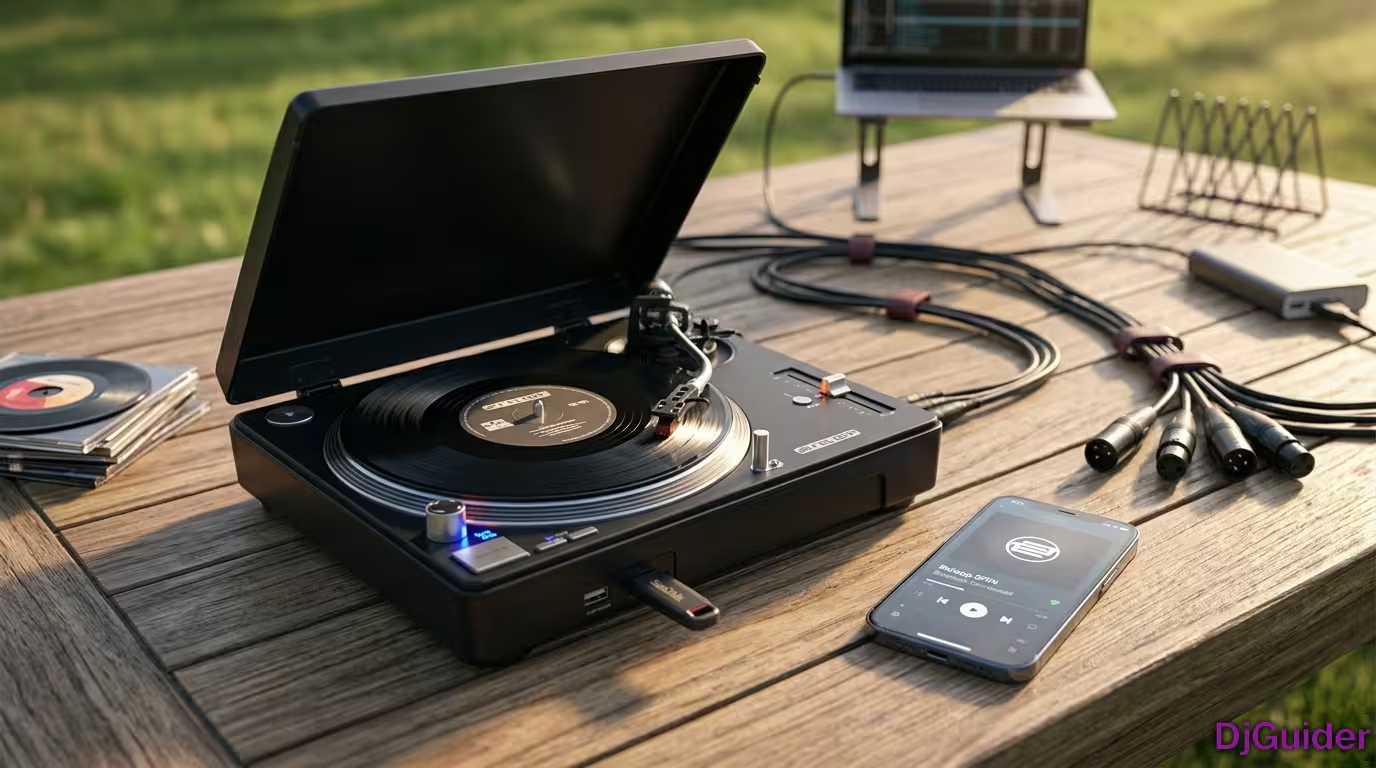
The Reloop SPIN is the best portable turntable on the market today — a clear upgrade over the Numark PT01 Scratch. This review covers:
- Build: All-plastic belt-drive portable, solid platter, Vestax Handy Trax-inspired design
- Power: USB power bank or 18650 rechargeable batteries — best power system on any portable
- Bluetooth: Built-in for wireless beat input from any phone or tablet
- USB Recording: Direct to USB stick — worth the price alone
- Crossfader: Full-size 45mm swappable fader, user-replaceable
- Downsides: Long cut-in distance on stock fader, pitch accuracy varies
The first thing to say about the Reloop SPIN itself is that this is surprisingly only the second turntable to hit the mass market designed for portable-ism. Up to now, it's been either a Numark PT01 Scratch or a regular portable with an external fader.
There are at least a couple of other projects coming with people trying to make other portable turntables, but in stores at the moment, it's head to head between this and the PT01 Scratch.
What You Get
| Spec | Detail |
|---|---|
| Drive | Belt drive |
| Inputs | AUX 3.5mm stereo, Bluetooth audio |
| Outputs | Master RCA, USB (USB-A), headphones 3.5/6.3mm |
| Recording format | MP3 256 kbit/s |
| Recording quality | 16 bit / 44.1 kHz |
| Battery type | 2x Li-Ion 18650 (sold separately) |
| Power supply | 5V, 2A micro USB (PSU sold separately) |
| Dimensions | 370 x 95 x 260 mm |
| Weight | 2 kg |
Build Quality
With a street price of around $200, you can't go expecting miracles from the build of the SPIN. It's an all-plastic belt-drive turntable with the kind of plastic arm and ceramic stylus that you find on most other portables.
That means it's never going to fulfill the dreams of people like me who DJ with 45s and would love a dedicated high-end portable turntable. But something like that would cost substantially more and is fundamentally too niche to be a viable prospect.
At $200, you get a plastic turntable with a ceramic cartridge — that's the reality of the portable market. But the SPIN does everything well within those constraints.
Design
The design is incredibly reminiscent of the old Vestax Handy Trax, especially with the lid on. Once you open it up, things are laid out a bit differently, but a lot of the main components are very similar.
| Feature | Detail |
|---|---|
| Tonearm | Bent at cartridge end, rests on knob or in slot |
| Stylus guard | Built into the slot next to the platter |
| Cartridge | Ceramic stylus — basic but functional |
| Arm weight | Fairly substantial — holds the groove well |
| Vintage vinyl | Not ideal for precious records |
The tonearm rests in two places when not on the record — either on the little knob for temporary placement or down in a slot next to the platter. This slot incorporates the stylus guard and holds the arm in place very securely.
The Platter
| Feature | Detail |
|---|---|
| Stability | More solid than PT01 for up/down movement |
| Top surface | A little grippy |
| Slip mat | Supplied Reloop mat works OK |
| My preference | Butter Rug + Dr. Suzuki donut combo |
The platter is more solid than the PT01 when it comes to up-and-down movement as you push down on the sides, which is nice. The top surface is a little grippy for my liking, and although it slips pretty well with the supplied Reloop slip mat, I found myself quickly switching out for my preferred Butter Rug and Dr. Suzuki donut combo.
Belt Drive Performance
Being belt drive, the motor torque isn't on par with direct drive turntables, but as I've always found on portables, it's plenty good enough — especially as you're working with 7-inch vinyl which is much lighter than 12-inch.
| Factor | Detail |
|---|---|
| Motor torque | Not direct drive level, but adequate |
| 7-inch vinyl | Works great for scratching |
| 12-inch vinyl | Plays fine, but not ideal for scratching |
| Battle record | Included in the box |
It's worth noting the SPIN can play 12-inch records just fine — you're just not going to have a lot of joy scratching with them. You do get a 7-inch battle record included in the box with skips samples on one side and beats on the other. The producer Zhu Cal sampled me saying "the SPIN" at the beginning of each side — a great touch.
Power System
The power system is the best I've seen on a portable to date.
| Power Feature | Detail |
|---|---|
| Main power | 5V via micro USB (2A or higher) |
| Wall charger | Any phone/tablet charger works |
| USB power bank | Yes — hours of use away from mains |
| 18650 batteries | 2x rechargeable Li-Ion cells (sold separately) |
| Charging | Plugging into wall charger charges the 18650s |
The SPIN requires 5-volt power which means you can power it from any phone or tablet wall charger with a 2 Amp or higher output. It would've been nice to get one in the box though.
The battery compartment on the bottom has space for a pair of rechargeable 18650 batteries. You may not be familiar with those, but they're high-power lithium-ion cells widely used in vape devices — easy to get hold of.
Even better: plugging the SPIN into a wall charger or power bank charges those 18650s. You can carry a couple of power banks or spare 18650s and never run out of juice.
I'm sure some people would have preferred a built-in battery, but I like the way Reloop has done this. The choice is yours — power bank, wall charger, or 18650s. You'll never be caught without power.
Front I/O
| Port | Details |
|---|---|
| AUX input | 3.5mm stereo for playing beats |
| Speaker | Notably louder than PT01 Scratch |
| Kensington lock | Great for schools and youth organizations |
| USB port (USB-A) | For recording to USB stick |
| Headphone jacks | Both 3.5mm and 6.3mm |
| Master output | RCA |
| Power switch | On/Off |
| Micro USB | For power input |
Both the headphones and master output cut out the speaker when they're connected — exactly what you want.
Top Panel: Controls
All the controls live on the right-hand side:
| Control | Function |
|---|---|
| Start/Stop button | Platter on/off |
| Main volume | Master level control |
| Aux level | Input level for external sources |
| Bluetooth pairing | Pair with phone or tablet |
| Tone control | Counter-clockwise reduces bass |
| Speed selector | 33, 45, and 78 RPM |
| Pitch control | +/-20% range |
Bluetooth Connectivity
Having Bluetooth on here is fantastic. The best mod I did on my first PT01 Scratch was adding the Scratch Toys Sound Plates which gave me Bluetooth input. Pairing is simple and straightforward, and it means you can instantly connect pretty much any phone or tablet without needing any cables.
I've been running it constantly with a table of beats on my iPhone with zero hitches.
The Bluetooth on the SPIN works flawlessly. No cables needed — just pair your phone and you have an instant beat source. This is huge for portable scratching setups.
Tone Control
The tone control confused me at first — turning it counter-clockwise reduces the bass. It's more of a basic cut and works fine. I am pleased to report it only affects the main output and not the aux, which is exactly what you want.
Pitch Control
The pitch control is wide, offering +/- 20% in each direction. On my unit, the zero mark plays at almost +4% in Serato DJ Pro, with the upper and lower limits similarly impacted. I've never known any similar portables to be especially accurate on that front, and that will probably change over time as the belt stretches. Just something to be aware of if using it for anything besides cutting.
Crossfader
On a portable table, the fader is hugely important, and the situation on the SPIN is pretty cool.
| Fader Feature | Detail |
|---|---|
| Type | Full-size 45mm twin rail |
| Placement | Two slots — left or right, your choice |
| Stock performance | Respectably sharp cuts |
| Cut-in distance | Rather long (criticism) |
| Swapping sides | 2-minute job with a screwdriver |
| Third-party faders | Supported — connections ready |
Swapping Fader Sides
It comes with a full-size 45mm twin rail fader which can be placed into either of the two slots, whichever way round you like. If you decide you want it on the left, hamster-style, it's a two-minute job to swap it over.
Inside the two slots are identical pairs of connections — one red and one white. The white ones are used by the stock fader, and the red ones are for third-party faders, making them equally easy to fit. There's even the potential to use an extra fader in the second slot as a line fader.
The stock fader performs pretty well with respectably sharp cuts, but the cut-in distance is rather long. It's usable for sure, but a lot of users will quickly want to swap in a third-party replacement — like the Innofader or Jesse Dean Designs fader — or revive the old credit card mod. At least if you decide to swap it out, the process is dead simple.
USB Recording
At this time, the SPIN is selling for about twice the price of the PT01 Scratch. And for me, the recording feature alone makes that worth it.
| Feature | Detail |
|---|---|
| Format | FAT32 USB stick |
| Recording | Press record to start, press again to stop |
| Levels | Dependent on SPIN main controls |
| Quality | 192K MP3 |
| Use cases | Shooting videos, hearing your cuts back |
A few weeks back I was in Prague with some colleagues. We decided to shoot some portable cuts on a pedal boat just for fun. With the PT01 Scratch, it wasn't fun at all. We managed to sort out the power, but we didn't have the right cables to connect our phones for beats and record direct audio. We'd have to cut the speaker so the person scratching couldn't hear anything, and the fader slot was on the wrong side for them.
All of those problems would simply be non-existent on the SPIN.
Whether you're shooting videos or just want to hear your cuts back as you practice, the USB recording is truly worth its weight in gold. This alone makes the SPIN worth the extra cost over the PT01.
Conclusion
As much as I will forever give props to the Numark PT01 Scratch, if I was buying a portable turntable today — even though it costs more — this would be it.
What It Does Well
- Power management — USB power bank + 18650 batteries, best in class
- USB recording — Direct to USB stick at 192K MP3
- Bluetooth — Wireless beat input, works flawlessly
- Swappable fader — Full-size 45mm, easy to swap sides or replace
- Design — Solid platter, Vestax Handy Trax-inspired
- Speaker — Louder than PT01 Scratch
- 78 RPM support — Plays 78s as well
What Could Be Better
| Issue | Why |
|---|---|
| Long cut-in distance | Stock fader needs replacement for serious cutting |
| Pitch accuracy | Zero mark was off by ~4% on my unit |
| All-plastic build | Expected at this price point |
| No power supply included | Micro USB cable only |
My Verdict
| Aspect | Rating |
|---|---|
| Power system | ⭐⭐⭐⭐⭐ |
| Bluetooth | ⭐⭐⭐⭐⭐ |
| USB recording | ⭐⭐⭐⭐⭐ |
| Build quality | ⭐⭐⭐ |
| Stock fader | ⭐⭐⭐ |
| Value for money | ⭐⭐⭐⭐ |
| Overall | ⭐⭐⭐⭐ |
There's no doubt this is a bit of a slam dunk for Reloop. The power management is superb, the direct USB recording is my favorite feature, and the Bluetooth connectivity is excellent.
The one thing that lets it down ever so slightly is the cut-in distance on that stock crossfader — it's just a hair too long. But it's really simple to swap out for a third-party replacement, and there are already plenty available — the Innofader and Jesse Dean Designs faders both work great.
If you want the latest and greatest in portable tech, something affordable, the Reloop SPIN is absolutely the best choice.