Table of Contents▼
In This Article
- Why a DJ Who Survived a Stroke Has Earned the Right to Talk About This
- The Logic Behind Spending More on Lighter Gear
- Start With Your Shoes — Seriously
- Anti-Fatigue Mats Are a $20 Game Changer
- Why the ADJ Pro Event Table Protects Your Back
- Compact Column Arrays: Lighter, Easier, and Surprisingly Better
- Adding Subwoofers Without Destroying Your Back
- Electro-Voice EKX 15-Inch Sub
- FBT Subline 112 SA
- Stop Carrying Cables You'll Never Use
- Running a Lightweight Laptop and Tablet Backup
- Wireless Battery-Powered Lighting Eliminates Setup Pain
- The Philosophy That Makes It All Work
- Equipment Summary
Why a DJ Who Survived a Stroke Has Earned the Right to Talk About This
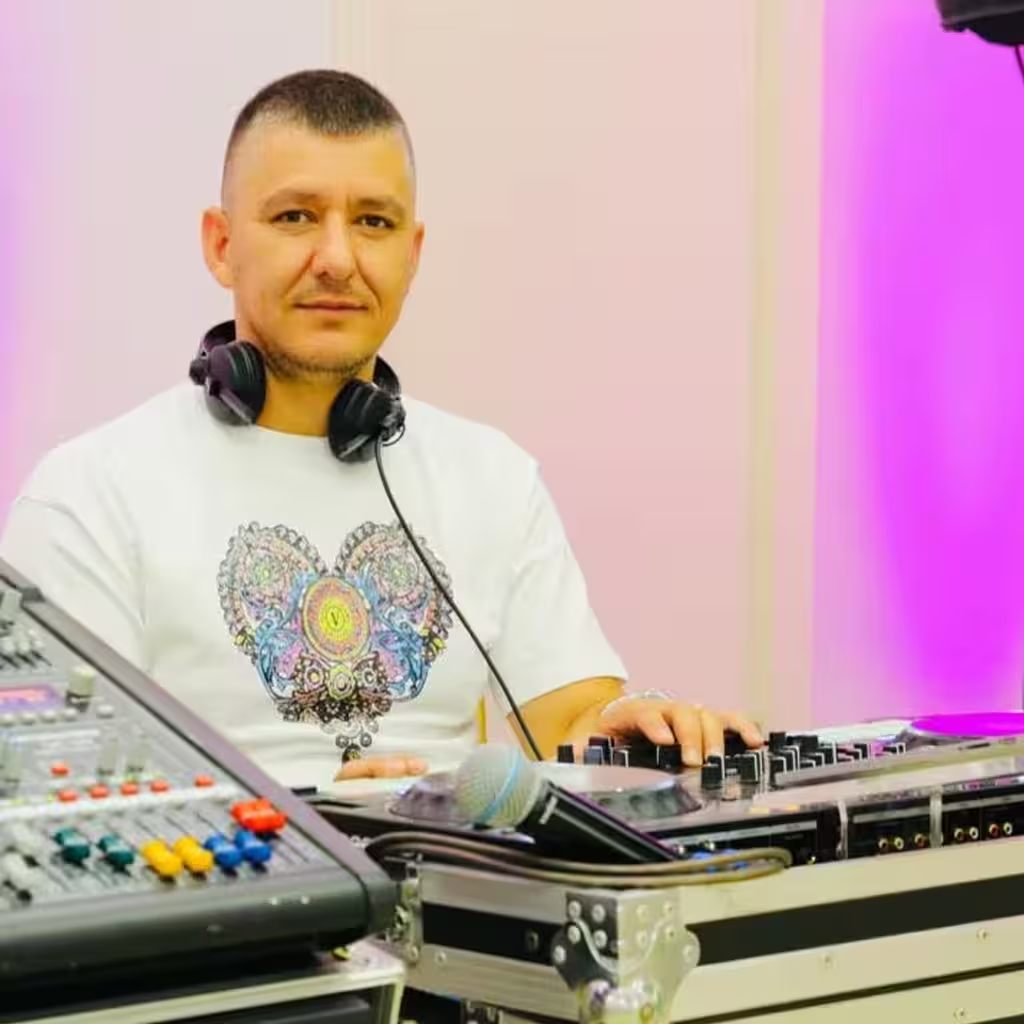
Fifteen years ago, Brian had a massive stroke that took out half of his body.
His right arm doesn't really do much of anything. His leg's not great. He had to figure out how to DJ with these limitations.
He figured some things out, and he's doing it today. He's 55 years old, and he can't tell you that he's walking around in massive pain about it. He has the same problems 55-year-olds have plus all that other crap, and he's still doing it.
Fifteen years ago, Brian had a massive stroke that took out half of his body. He had to figure out how to DJ with these limitations. He's 55 years old, still DJing, and not walking around in massive pain. His gear and posture tips come from real experience.
The Logic Behind Spending More on Lighter Gear
About three or four years before his stroke, Brian bought Crown I-Tech amplifiers at Canal Sound & Light in New York City.
They were very expensive, but they were 17 lb. He was replacing his Crown Macro-Tech amps that were like 60 lb.
Although the I-Techs were expensive, the way he reasoned it out in his head was it was a lot cheaper than back surgery. He uses the same logic when selecting equipment today.
It might cost a little more, but if it's lighter and more capable and more manageable, it makes it possible to continue to DJ.
It might cost a little more, but if it's lighter and more capable and more manageable, it makes it possible to continue to DJ. Whatever the price of this stuff, it's cheaper than back surgery.
Start With Your Shoes — Seriously
The first thing to address is footwear, and it matters more than most DJs think.
Brian has been living in New Balance 612s since his stroke. They keep his balance, they've got a great grip, and they don't hurt his feet.
Inside them he uses Dr. Scholl's inserts picked up at Target. He calls this a lifesaver.
Instead of wearing a dress shoe or even a cool trendy shoe, it's important to wear a comfortable shoe because the wrong footwear puts pressure on your lower back. A good shoe is going to help you a lot. Insoles are going to help you a lot.
And quite frankly, if it's black, no one's going to notice. No one's going to look at your feet. Black tennis shoes are just easy.
A good pair runs about $150, and Brian replaces them roughly every six months. Nobody has ever said a word to him about wearing tennis shoes.
- Shoes — New Balance 612s or similar athletic shoe (~$150, replace every 6 months)
- Insoles — Dr. Scholl's inserts (available at Target)
- Colour — black, nobody looks at your feet
- Benefit — reduces pressure on lower back, improves balance and grip
Anti-Fatigue Mats Are a $20 Game Changer
If you're working on gym floors, stages, tile floors, or concrete, that can suck if you're standing there for a long time.
Brian picked up an anti-fatigue mat off Amazon for under $20. It's great just to stand in front of your decks while you're DJing.
He doesn't have a problem on carpeted floors, but if it's wood, bouncy stage, or plywood — stages are never comfortable. Tile, any of that — pick up an anti-fatigue mat. They make such a difference.
Under $20 on Amazon. If you're working on wood, tile, concrete, or plywood stages, it makes such a difference. On carpeted floors you probably don't need it.
Why the ADJ Pro Event Table Protects Your Back
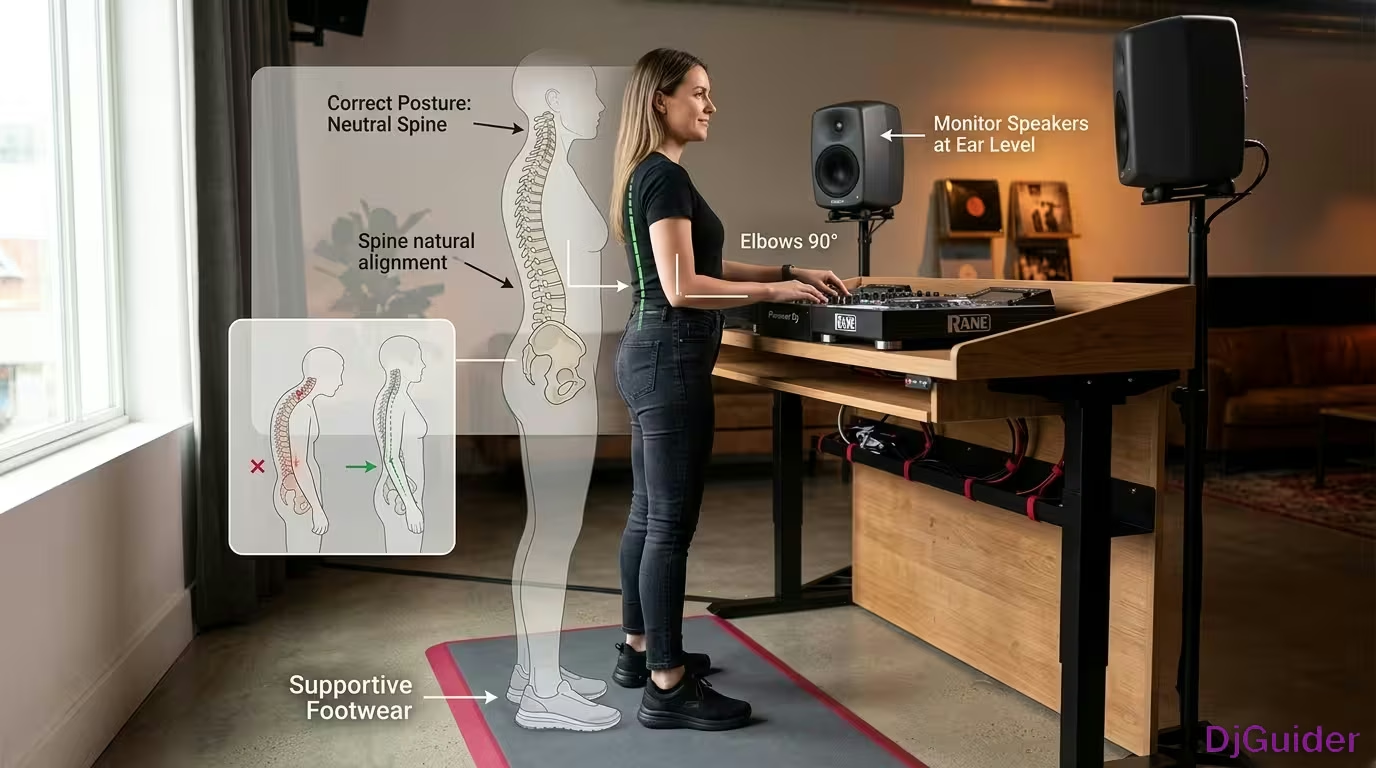
The ADJ Pro Event Table, powder-coated black, solves a problem most tall DJs don't even realise they have.
At first thought, a lot of DJs think carrying a table is a lot of weight and they could reduce that by just using whatever banquet table the hall has available. That reasoning is understandable, but there's something not being considered — especially for DJs of a certain height.
At around 6 ft tall, using a regular banquet table means hunching over and leaning into your stuff. The Pro Event Table puts everything at a height that makes more sense.
The top of this table is 35 inches. Add a rack and it's almost 40 inches, and you're not hunching over at all. You're standing up nice and straight, the stuff's right in front of you.
If you position your laptop stand right, you're not leaning over to type either. Standing up straight and not hunching is really going to help your fatigue a lot. It's going to eliminate it.
The combination of the Pro Event Table and the anti-fatigue mat together — they're really a lifesaver sometimes.
The ADJ Pro Event Table has a 35-inch top. Add a rack and it's almost 40 inches. For DJs around 6 ft tall, this eliminates hunching entirely — your equipment is right in front of you at a natural height.
| Table Type | Height | Effect on Posture |
|---|---|---|
| Standard banquet table | ~29 inches | Forces hunching for taller DJs |
| ADJ Pro Event Table | 35 inches (40 with rack) | Standing straight, no leaning |
Compact Column Arrays: Lighter, Easier, and Surprisingly Better
Brian is a big advocate for compact array systems for several reasons.
One, they don't weigh a lot. The 10-inch Evolve 30M is not bad to pick up at all. You can do the Evolve 50s, which weigh a little more, but for weddings up to about 150 people the 30M does the job.
A lot of people like two-way top cabinets on tripods. Brian eliminates tripods with column arrays entirely, and they go up and down really quick. It's about trimming fat sometimes. You have to figure out what you can do without and what you can eliminate.
He also eliminated that harshness of mids. Anything that's horn-loaded produces mid-frequencies that tend to compete with vocals when people are talking. The human voice is about 70 dB in conversation. The horns are going to be louder than that, so people start putting their fingers in their ears and giving you dirty looks — especially during dinner.
The cool thing about compact arrays is they're not using horns. They're using full-range little speakers in the column, and the mid-frequency is not competing with vocals. The highs are there. The mids aren't overbearing. And the lows are there.
Everything goes into a little backpack — all the poles, everything.
Column arrays eliminate tripods, go up and down quickly, and pack into a backpack. They don't use horns, so mids don't compete with vocals — people won't put fingers in their ears during dinner.
Adding Subwoofers Without Destroying Your Back
Some DJs out there are just bass-horny — and there are smart, lighter options to get that boom.
Electro-Voice EKX 15-Inch Sub
This is a 15-inch sub, and for a 15-inch sub it's relatively lightweight and works just fine. Brian doesn't usually use subs at wedding receptions, but sometimes at a large hall for kids and adults he'll add a single — and that's enough.
FBT Subline 112 SA
This sub does something the EKX doesn't — it has a high-pass filter out. On a subwoofer, there's a built-in low-pass filter that only accepts frequencies below around 100 Hz. Unfortunately, speakers like the Evolve 30M don't have a high-pass filter, so that little woofer is taking a full range of sound with nothing filtering it.
The FBT Subline 112 SA sends out a high-pass filter signal, which crosses over your whole system and makes it a three-way system. It's physically smaller than the EKX 15. The weight isn't much different because FBT puts some pretty heavy equipment in this thing, but it is physically smaller and it gives you the high-pass filter out.
This acts like a 15. It's pretty powerful. Anybody who's used it will tell you it's a wicked little sub. If you're taking one single sub out and you want some boom, that little 12 is so incredibly capable. It'll rock the house.
- EV EKX 15-inch — relatively lightweight 15, no high-pass filter out, good for large halls
- FBT Subline 112 SA — physically smaller 12-inch with high-pass filter out, acts like a 15, wicked powerful
- Brian's rule — avoid subs at weddings unless absolutely necessary; heavy and unnecessary for most events
Brian tries to avoid subwoofers at weddings. They're heavy, and he's not trying to crack foundations or knock grandma's dentures out of her mouth in the back of the room.
For big school dances, he'll run a full EKX rig. It's heavy, and it hurts to set up. But for most social events he can get away with a column array, and even with 300 people he can add one sub and it's more than enough.
Stop Carrying Cables You'll Never Use
In one beat-up old cable bag is every cable Brian brings to every event — and it doesn't weigh that much.
He knows people who are hauling around cables they're never going to use, with redundancies after redundancies. Whatever your quirk is — whether it's ADHD, obsessive compulsive, whatever — de-program your brain. It's going to save your back.
Here's exactly what he carries:
- Two IEC cables for the speakers
- Two to three extension cables to reach the wall
- Two XLR cables to hook speakers to the controller mixer
- Extra IECs, extra XLRs, extra standard extension cords, one extra long extension cord
He doesn't need 12 XLRs when he's only using two at most events. If he's running a sub he needs four, so he carries five — one extra. That's it. Lighten your load. You don't need all of these redundancies.
He knows people who are hauling around cables they're never going to use, with redundancies after redundancies. Lighten your load. You don't need all of these redundancies. It's going to save your back.
| Cable Type | How Many You Actually Need |
|---|---|
| IEC cables | 2 for speakers |
| Extension cables | 2–3 to reach the wall |
| XLR cables | 2 for basic, 5 if running a sub (1 spare) |
Running a Lightweight Laptop and Tablet Backup
Brian's main laptop is an Alienware that weighs about 5–6 lb with an SSD drive.
It's fast, it runs his programs fantastic, and it's going to be his laptop for many years. His old ASUS Republic of Gamers laptops weighed like 15 lb plus the bag — heavy stuff.
He doesn't run a second laptop for backup. Instead, he runs tablets. Little headphone jack out of the tablet into the aux of the mixer will get him through the night if he has a problem with his computer. No big deal.
Instead of a second heavy laptop, use a tablet with a headphone jack into the aux input of your mixer. It'll get you through the night if your computer fails — and weighs next to nothing.
Wireless Battery-Powered Lighting Eliminates Setup Pain
Wireless battery-powered lighting is the way to go if you want to cut setup effort dramatically.
You don't have to get on the ground and hook up a bunch of cables. You don't have to program any crazy DMX if you don't want to. Brian does the uplighting thing using Ape Labs because he really likes the control — super easy, super dependable.
There are budget options out there that aren't expensive and kind of sort of work, with a slightly more clumsy remote. But if you're not in a position to buy premium stuff, do what you got to do. Just make sure you're able to still work.
He doesn't use any light trees anymore. Everything is on the ground uplight. He washes the room, and it's an elegant look for weddings. There are no stands and trees with little bars and combo fixtures — he's over that.
He thinks it's a better look to have just the pars lighting up the room in a thoughtful way around the dance floor, washing the crowd. It also eliminates the tripod and eliminates something heavy to carry.
The hardest thing at the end of the night is bending down to pick up the lights individually. Sometimes he'll scoot around with a rocket roller cart to pick them up so he's not up and down so much.
- Ape Labs — premium, easy control, super dependable
- Budget options — exist but remotes can be clumsy
- Light trees — eliminated entirely, everything on the ground
- End of night — use a rocket roller cart to avoid repeated bending
The Philosophy That Makes It All Work
Any time tech comes out that makes the job easier, it's worth being on top of it — and sometimes it's not a cheap date.
But whatever the price of this stuff, it's cheaper than back surgery. And that's how Brian looks at it.
Any time tech comes out that makes the job easier, it's worth being on top of it. Whatever the price of this stuff, it's cheaper than back surgery.
Equipment Summary
| Item | Key Notes | Best For |
|---|---|---|
| New Balance 612s + Dr. Scholl's inserts | Great grip, balance, comfort — around $150, replace every 6 months | All-night standing on any surface |
| Anti-fatigue mat (Amazon) | Under $20, reduces fatigue on hard floors | Wood, tile, concrete, plywood stages |
| ADJ Pro Event Table | 35-inch top height, eliminates hunching for taller DJs | Any DJ around 6 ft tall |
| EV Evolve 30M | Lightweight 10-inch column array, handles up to ~150 people | Weddings, smaller social events |
| EV EKX 15-inch sub | Relatively lightweight for a 15, no high-pass filter out | Large school dances, bigger rooms |
| FBT Subline 112 SA | Physically smaller 12-inch sub with high-pass filter out, wicked powerful | Single-sub setups needing crossover control |
| Ape Labs uplights | Wireless, battery-powered, easy remote control | Elegant wedding uplighting without cable runs |
| Tablet backup | Lightweight alternative to second laptop via headphone-to-aux cable | Emergency DJ backup |